
Decoding Needle Count: Its Role in Enhancing Efficiency and Quality of Industrial/Commercial Embroidery Machines
Decoding Needle Count: Its Role in Enhancing Efficiency and Quality of Industrial/Commercial Embroidery Machines
Abstact
In the embroidery industry, frequent thread-change downtime and color breaks often hinder production efficiency and product quality, particularly when handling complex patterns. This paper demystifies the role of "needle count"—a critical yet underrated parameter of industrial/commercial embroidery machines—and explains how it acts as a strategic lever for optimizing production flow and embroidery quality. Additionally, it provides a data-driven guide for selecting the appropriate needle count based on business scenarios and introduces Yinghe, a professional embroidery equipment manufacturer, as a reliable partner for leveraging needle count value.
1. Introduction
For stakeholders in the embroidery sector—from small workshops to large-scale factories—production efficiency and product quality are core competitive advantages. However, challenges such as delayed progress due to repeated thread changes and dull designs caused by limited color options persist. These issues are closely tied to a key technical parameter: the needle count of embroidery machines. Unlike the number of heads (which refers to the number of simultaneous embroidery frames), needle count denotes the number of distinct colored threads a single machine head can load and utilize concurrently. This paper systematically analyzes the impact of needle count on efficiency and quality, and offers practical selection criteria for industrial/commercial embroidery machines.
2. Definition and Classification of Needle Count
2.1 Definition of Needle Count
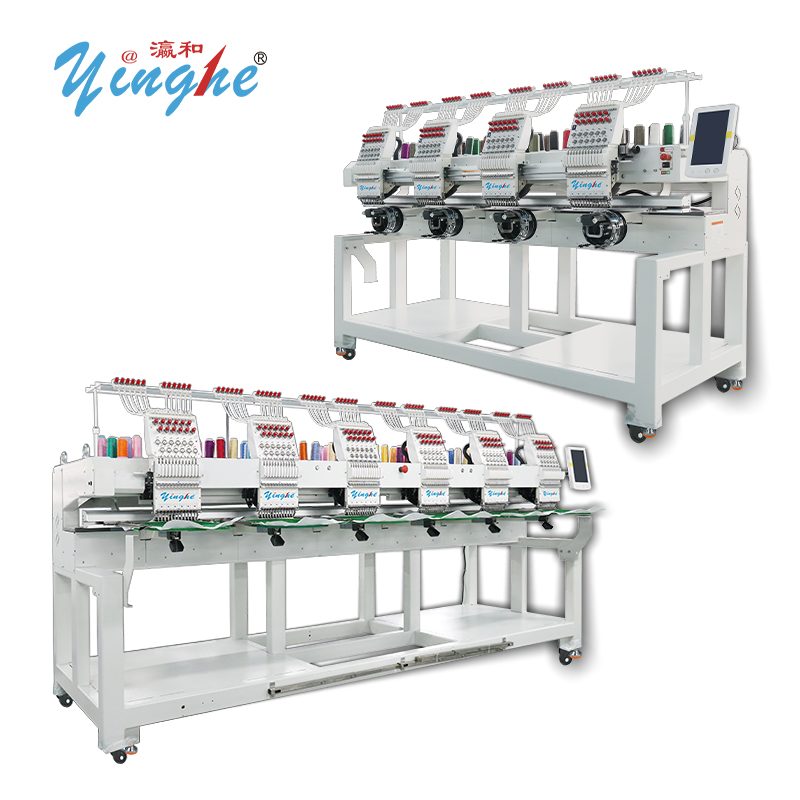
Needle count is defined as the maximum number of different colored threads that one embroidery machine head can pre-load and switch between seamlessly. A common misconception—equating needle count with head count—is clarified here: head count reflects the parallel embroidery capacity (number of frames operating simultaneously), while needle count represents the independent color-switching capability of each individual head.
2.2 Classification by Needle Count
- Single-needle machines: Basic models limited to single-color embroidery. They are cost-effective for simple tasks but inefficient for multi-color projects due to mandatory thread changes.
- Multi-needle machines: Mainstream models for modern industrial/commercial applications, with common specifications including 6-needle, 9-needle, 12-needle, 15-needle, and higher. These machines pre-load multiple colored threads in dedicated needle positions, enabling uninterrupted color switching.
3. Needle Count as an "Efficiency Manager"
For batch production and large-scale operations, needle count directly determines production throughput by minimizing non-value-added downtime.
3.1 Reduction of Thread-Change Downtime
Simulation data indicates that for a pattern requiring 12 colors, a 12-needle industrial machine completes the task in one pass, whereas a 6-needle machine requires at least one thread change—saving up to 30% of non-productive time (depending on pattern complexity). Fewer interruptions significantly boost overall production efficiency.
3.2 Optimization of Complex Order Processing
High-needle machines (e.g., 12-needle or above) support rapid color-scheme switching for small-batch, multi-color orders without repeated threading. This flexibility aligns with the demand for "flexible manufacturing" in the modern embroidery industry.
3.3 Synergy with Other Parameters
Needle count must be coordinated with head count and machine speed to maximize efficiency. For example, a 12-head 12-needle machine outperforms a 6-head 24-needle machine in most scenarios, as it balances multi-thread capability with parallel embroidery capacity—avoiding bottlenecks caused by mismatched parameters.