
2026 Embroidery Machine Buying Guide: From Home Use to Factory Production
Content Table
1. Core Purchasing Parameters (Key Focus in 2026)
1. Core Purchasing Points for Small Commercial/Studio-grade Embroidery Machines
2. Pitfall Avoidance Skills for Purchasing Small Commercial/Studio-grade Embroidery Machines
2. Pitfall Avoidance Skills for Purchasing Industrial-grade Embroidery Machines (Key Focus in 2026)
Part 4: 2026 General Embroidery Machine Buying Guide (Applicable to All Levels)
1. Define Needs First, Then Choose Equipment
2. Prioritize Brands with Good Reputation and Comprehensive After-sales Service
3. Cost-effectiveness ≠ Low Price, Balance Quality and Practicality
4. Pay Attention to 2026 Embroidery Machine Industry New Trends and Adapt to Future Needs
Embroidery machines are practical intelligent devices whose application scenarios have expanded from personal DIY and home decoration to clothing mass production, cultural and creative customization, industrial marking, and other fields. In 2026, with the upgrading of embroidery technology towards intelligence and refinement, coupled with the digital transformation trend of the textile industry, the differences between personal-grade, commercial-grade, and industrial-grade embroidery machines have become increasingly obvious, and their purchasing logics also have different focuses.
This guide will break the hierarchical barriers and help you accurately select an embroidery machine that suits your needs from four dimensions: demand positioning, core parameters, brand recommendations, and pitfall avoidance skills. It balances cost-effectiveness and user experience, fully adapting to the 2026 industry technology trends and market demands.
Part 1: Small Home Embroidery Machines (Semi-automatic/Full-automatic, Suitable for Personal DIY and Efficient Production of Simple Embroidery)
1. Core Purchasing Parameters (Key Focus in 2026)
- Number of Needles: Beginners choose 1-4 needles (simple operation, affordable price, suitable for simple patterns such as letters and small flowers); advanced enthusiasts choose 6-12 needles (can embroider multi-color patterns, support simple color changing, and adapt to various scenarios such as clothing and pillowcases). There is no need to pursue too many needles to avoid functional redundancy and complex operation. In 2026, the needle count design of home models is more suitable for beginners, and multi-needle models have also optimized the operation logic to reduce the difficulty of getting started.
- Embroidery Area: The mainstream home embroidery area is 10cm×10cm-20cm×30cm, which is sufficient to meet personal DIY needs. An overly large area will make the machine bulky and expensive, while an overly small area will limit the size of embroidery (such as unable to make large paintings). Some new models support expandable embroidery hoops, balancing compactness and practicality.
- Operation Difficulty: Prioritize models with touch screens, one-click start, and built-in preset patterns. In 2026, home models generally add functions such as "beginner mode", "real-time progress reminder", and "thread change alert". Some high-end entry-level models also integrate AI pattern conversion function, which can automatically convert photos and hand-drawn patterns into embroidery data, breaking the dependence on professional design capabilities. At the same time, they support USB import of custom patterns to meet advanced needs. Matching with dedicated APPs (such as Brother's "Artspira") enables mobile phone editing and real-time transmission, further simplifying operation. It is even possible to draw patterns on tablets and synchronize embroidery directly, making creativity realization zero-threshold.
- Compatibility: Support multiple fabrics (cotton, linen, silk, thin denim) to avoid being limited to a single fabric and restricting usage scenarios; some models integrate dual functions of sewing and embroidery, with higher cost-effectiveness, suitable for daily mending and DIY. In 2026, new models add infrared laser fabric edge detection function, which can automatically adjust the stitching speed according to the fabric movement speed, effectively improving the finished product quality and operation efficiency.
- Noise and Size: The noise of home models should be controlled within 60 decibels (to avoid affecting family members), with a compact size (storable under wardrobes and desks) and weight not exceeding 10kg for easy movement.
Part 2: Purchasing Small Commercial/Studio-grade Embroidery Machines (Suitable for Personal Studios, Small Cultural and Creative Stores, and Customization Shops)
Core Needs: Balance efficiency and precision, support small-batch customization (such as clothing printing and embroidery, cultural and creative product customization, gift embroidery), adapt to various fabrics and complex patterns, have higher cost-effectiveness than industrial-grade machines, and lower operation difficulty than pure industrial equipment. In 2026, such models are upgraded towards intelligence and miniaturization, adding functions such as AI pattern editing and batch import, which meet the lightweight needs of cultural and creative entrepreneurship and become a popular choice for personal entrepreneurship.
1. Core Purchasing Points for Small Commercial/Studio-grade Embroidery Machines
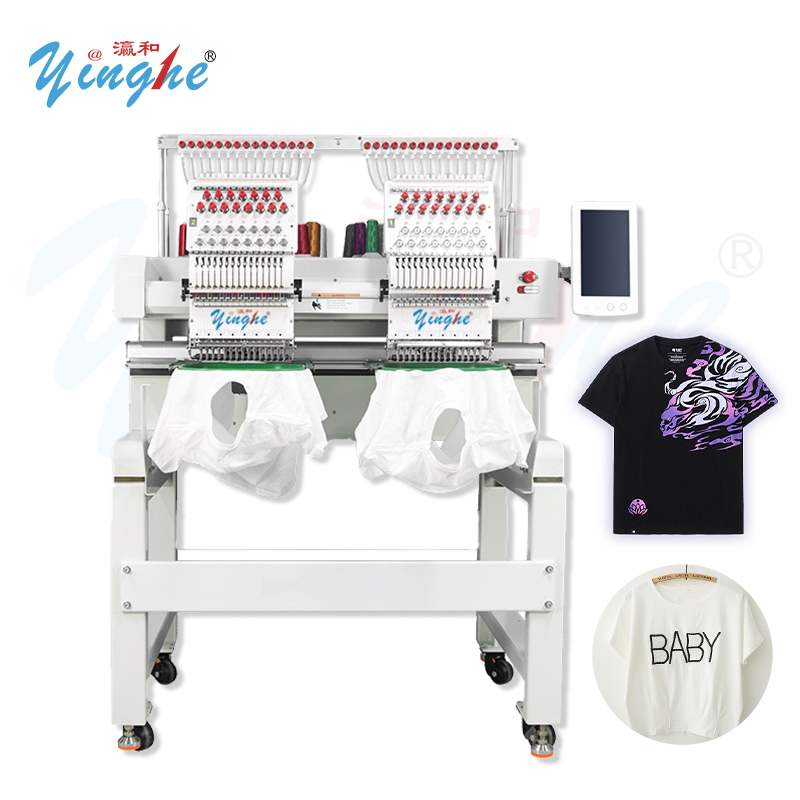
- Equipment Type: Prioritize small commercial embroidery machines (single-head/double-head). Different from home machines, they have higher motor power and stronger stability, supporting continuous operation for 4-8 hours, suitable for small-batch production (50-200 pieces per day); some models support dual functions of flat embroidery and appliqué embroidery to meet diverse customization needs, and a few high-end models can expand special embroidery functions to adapt to personalized customization scenarios such as trendy toys and fashion.
- Core Parameters: 12-15 needles (support automatic multi-color thread changing without manual thread changing to improve efficiency), embroidery area of 30cm×40cm or more (adapt to large embroidery such as coat backs and large paintings), speed of 800-1000rpm (higher than home machines to improve production efficiency), support computer connection operation (can batch import and edit patterns). In 2026, mainstream models support simple AI pattern modification functions, which can quickly adjust pattern size and style to adapt to different customization needs.
- Compatibility: Support multiple fabrics such as cotton, linen, silk, denim, and leather to adapt to different customization needs (such as leather bag embroidery and denim jacket embroidery); support multiple thread types (cotton thread, polyester thread, metal thread) to improve the diversity of embroidery; some models add fabric detection function, which can automatically adjust the stitching force according to the fabric thickness to reduce the rejection rate.
- Stability and After-sales Service: The motor should be durable to support continuous operation and reduce failure frequency; choose brands with 24-hour after-sales consultation to avoid equipment failures affecting order delivery; the equipment should have thread breakage detection and stitch compensation functions to reduce the rejection rate; pay attention to consumable compatibility to avoid the equipment only using specific brands of threads and needles, which increases later use costs.
2. Pitfall Avoidance Skills for Purchasing Small Commercial/Studio-grade Embroidery Machines
Do not buy "commercial machines" modified from home machines (insufficient motor power, unable to work continuously, prone to failures); do not blindly pursue "multi-head"—single-head/double-head is sufficient for small studios. Multi-head models are expensive and take up large space, and are prone to waste when the order volume is insufficient; pay attention to equipment expandability, and prioritize models that can upgrade embroidery heads and add functional modules to adapt to future order type upgrades; verify the after-sales response speed to ensure that on-site maintenance can be carried out quickly when equipment fails, reducing downtime losses.
Part 3: Purchasing Industrial-grade Embroidery Machines (Suitable for Clothing Factories, Large Cultural and Creative Enterprises, Embroidery Processing Plants, and Mass Producers)
Core Needs for Industrial-grade Embroidery Machines in 2026: High speed, high efficiency, high precision, and high stability, supporting large-scale mass production (hundreds to thousands of pieces per day), adapting to various industrial fabrics (such as clothing fabrics, home textile fabrics, leather, and technical textiles), with intelligent management and control and fault early warning functions, which can be integrated into industrial production lines, balancing production efficiency and product consistency. At the same time, responding to the green and intelligent industrial trends, some models integrate robotic arms and AI vision technology, relying on scaling law technology to easily handle complex patterns and delicate stitches, realizing fully automated production.
1. Core Purchasing Parameters for Industrial-grade Embroidery Machines (Key Upgrade Directions in 2026)
- Equipment Type: Classify by purpose and prioritize corresponding models to avoid functional redundancy or insufficiency:
- Flat Embroidery Machines: The most versatile, suitable for flat embroidery (such as clothing fabrics, home textiles, and logos), occupying the mainstream position in the industrial-grade market. In 2026, mainstream models add IoT modules to support remote monitoring and data synchronization, which can be integrated into industrial internet systems;
- Towel Embroidery Machines: Suitable for three-dimensional velvet embroidery (such as towels, carpets, and stage costumes), with full stitches and strong three-dimensional effect;
- Chain Stitch Embroidery Machines: Suitable for leather and knitwear fabrics (such as leather jackets and sportswear), with firm threads that are not easy to fall off;
- Special Embroidery Machines (Sequin Embroidery and Laser Cutting Embroidery Integrated Machines): Suitable for high-end customization and fashion clothing. In 2026, the demand for such models will grow significantly, with an expected compound annual growth rate of 18.7%;
- Multi-head Machines: The mainstream is 6-48 heads. The more heads, the higher the mass production efficiency. Choose according to the daily output (6-12 heads are suitable for small and medium batches, 24-48 heads are suitable for large-scale mass production); some models are equipped with robotic arms, which can realize automatic feeding and threading without manual intervention, greatly improving production efficiency. Some single-head models also integrate ribbon embroidery, towel embroidery, and laser functions to expand application scenarios.
- Speed and Stability: Speed of 1000-1500rpm (uniform stitches without thread skipping or breaking under high-speed operation), the motor adopts industrial-grade servo motor, supporting 24-hour continuous operation (meeting the needs of three shifts in factories); the equipment should have shockproof and noise reduction design to reduce interference in the industrial production environment, and at the same time reduce energy consumption in response to the green production trend; some models adopt lightweight structural design, balancing stability and convenience, facilitating workshop layout adjustment.
- Precision and Intelligence: Stitch precision error ≤ 0.1mm (ensuring the consistency of mass-produced embroidery and avoiding defects); in 2026, industrial-grade models generally integrate AI visual recognition positioning, automatic color changing, thread breakage detection, and fault early warning functions, optimizing stitch control relying on scaling law technology, which can easily handle complex patterns and delicate stitches; support computer-connected batch typesetting, remote monitoring of equipment operation status, and predictive maintenance. Some high-end models support 5G connectivity and cloud-based collaborative work, greatly improving production efficiency and management and control levels; can realize data statistics and capacity analysis, facilitating refined factory management, in line with the digital transformation requirements of the textile industry.
- Compatibility and Expandability: Support multiple industrial fabrics (cotton, linen, polyester, leather, non-woven fabrics, technical textiles) to adapt to the needs of different industries; support multiple thread specifications, compatible with industrial-grade large-volume threads (reducing thread changing frequency); have expandability, and can add embroidery heads and upgrade functions (such as adding sequin embroidery modules) according to production needs to adapt to future capacity upgrades; some models support drive module upgrades, which can adapt to special production needs such as hand modules, improving product added value.
- Control System: Adopt full computer CNC system, easy to operate, supporting multilingual switching (adapting to different operators in the factory); have pattern editing and batch typesetting functions, which can quickly import custom patterns; support data statistics (such as output and number of failures), facilitating factory production management, in line with the development trend of industrial internet; some high-end models support AI automatic pattern optimization, which can adjust stitch density according to fabric characteristics to improve embroidery quality, in line with the development direction of integrating artificial intelligence and textile industry knowledge.
2. Pitfall Avoidance Skills for Purchasing Industrial-grade Embroidery Machines (Key Focus in 2026)
- Do not blindly pursue "high speed and multi-head", but choose according to your own output: 6-12 heads are sufficient for a daily output of less than 500 pieces; consider models with more than 24 heads only when the daily output exceeds 1000 pieces to avoid overcapacity and cost waste; the speed should match the fabric, for example, leather fabrics are not suitable for too high speed to avoid damaging the fabric, and priority can be given to models with speed adaptive function.
- Focus on after-sales service and accessory supply: Industrial-grade equipment failures affect mass production, so choose brands with fast after-sales response (on-site service within 24 hours) and sufficient accessory supply to avoid downtime due to lack of accessories; at the same time, require manufacturers to provide free installation and commissioning and technical training to ensure that operators can get started quickly, especially to be familiar with the operation of new intelligent functions such as AI visual positioning and remote monitoring.
- Be wary of "refurbished machines" and "assembled machines": Industrial-grade equipment is relatively expensive. Some merchants sell refurbished machines and assembled machines, which seem cheap but have poor stability, are prone to failures, and have no after-sales guarantee. When purchasing, check the manufacturer's qualifications and equipment certification, ask for official invoices and warranty certificates, and focus on verifying the originality of core components such as motors and control systems.
- Pay attention to intelligence and expandability: In 2026, industrial embroidery is transforming towards intelligence and digitalization. Avoid purchasing models without intelligent management and control and unable to be upgraded, otherwise it will be difficult to adapt to capacity upgrades and production management needs in the later stage, increasing the cost of equipment replacement; prioritize models that support the Internet of Things and remote...
Part 4: 2026 General Embroidery Machine Buying Guide (Applicable to All Levels)
1. Define Needs First, Then Choose Equipment
Clarify your own usage (personal DIY/studio customization/factory mass production), budget, output (or number of embroidery pieces), and fabric type to avoid blind follow-up purchases. For example: For beginners' personal DIY, there is no need to buy a multi-needle home machine; an entry-level 1-4 needle home machine is sufficient; for factory mass production, there is no need to buy a small commercial machine; directly choose an industrial-grade multi-head machine to improve efficiency. At the same time, combined with the 2026 industry trends, individuals and studios can focus on intelligence and convenience, while factories can focus on intelligence, greenization, and expandability, in line with the digital transformation direction of the textile industry.
2. Prioritize Brands with Good Reputation and Comprehensive After-sales Service
The durability and stability of embroidery machines are directly related to after-sales service, especially for home machines and industrial-grade equipment, which require professional maintenance after failures. Prioritize brands with good market reputation, long establishment time, and many after-sales outlets to avoid purchasing "three-no products" and reduce later usage troubles. According to industry data, in the domestic embroidery machine market in 2026, the combined market share of leading brands has exceeded 50%. Choosing mainstream brands is more reliable. At the same time, confirm whether the brand can provide later upgrade services for intelligent functions.
3. Cost-effectiveness ≠ Low Price, Balance Quality and Practicality
Low-priced equipment often has problems such as poor quality, poor stability, and insufficient functions, and is prone to failures in the later stage (such as thread skipping of home machines and thread breaking of industrial machines), which increases usage costs instead. When purchasing, prioritize comparing the parameters, quality, and after-sales service of equipment at the same price, and choose products with "parameters suitable for needs, reliable quality, and comprehensive after-sales service" instead of simply pursuing low prices. For example: Individuals can choose models with basic AI functions, balancing convenience and forward-looking; industrial-grade can choose energy-saving and intelligent models to reduce long-term operating costs, responding to the trends of green production and digital transformation.
4. Pay Attention to 2026 Embroidery Machine Industry New Trends and Adapt to Future Needs
- Intelligence: Home machines add beginner mode and AI pattern conversion functions, while industrial machines add AI visual positioning, remote monitoring, and fault early warning functions. When purchasing, priority can be given to products with intelligent functions to improve user experience and production efficiency, in line with the trend of artificial intelligence empowering the textile industry;
- Greenization: Energy-saving equipment and environmental protection consumable compatibility have become mainstream, especially for factories purchasing industrial-grade equipment. They can pay attention to energy-saving motors and environmental protection thread compatibility, responding to green production policies and reducing long-term usage costs;
- Personalization: Customization demand continues to rise. Individuals and studios can choose models that support custom pattern import and style conversion, while factories can choose industrial machines that support various special embroideries and personalized customization to adapt to diverse market demands;
In 2026, the core of purchasing embroidery machines is "demand adaptation, quality first, and trend consideration", while meeting the requirements of digital transformation and green production in the textile industry.
Personal-grade focuses on convenience and cost-effectiveness, prioritizing small models with simple operation and basic intelligent functions, balancing appearance and practicality;
Transitional grade (studio) focuses on efficiency and compatibility, choosing small commercial intelligent models to adapt to small-batch customization and paying attention to expandability;
Industrial-grade focuses on high speed, high precision, high stability, and intelligence, choosing corresponding models according to output, fabric, and usage, prioritizing after-sales service and expandability, rationally using tax incentives for imported equipment to reduce costs, and combining automated equipment such as robotic arms to improve production efficiency.
Regardless of the level, it is necessary to avoid blindly pursuing functional redundancy and low-price inferior products. Combine your own budget and actual needs to choose equipment with good reputation and comprehensive after-sales service, which can not only improve embroidery quality (or production efficiency) but also reduce later usage costs. With the continuous upgrading of embroidery technology in 2026, intelligence, greenization, personalization, and localization will become mainstream. Properly considering these trends when purchasing can make the equipment more practical and forward-looking, adapting to the long-term development needs of the industry.