DTF vs UV DTF Printing Film: Choose the Right Film to Double the Quality of Your Customized Products!
DTF vs UV DTF Printing Film: Choose the Right Film to Double the Quality of Your Customized Products!
If you have ever done personalized customization - such as printing a unique hoodie or making a customized phone case, you might have been confused about whether to use DTF film or UV DTF film. Choosing the wrong one not only affects the appearance of the final product but may also be a waste of effort (for example, the printed pattern may come off after two washes or the film may lift off the phone case).
Today, we will explain the core differences between these two types of printing films in plain language and with practical scenarios to help you avoid making mistakes when choosing films next time!
Content Table
I. First, understand that their "bases" are different (structure and material)
II. What's the difference in the process? It's about "heating or not"
III. Key! Which scenarios should you choose which? (Performance + application comparison)
IV. Cost & Environmental Impact: How to Choose Between Small Batch and Large Scale Production?
V. Summary: Three Steps to Choose the Right Printing Film
I. First, understand that their "bases" are different (structure and material)
The "structure" of the printing film directly determines what it can be adhered to and how durable it is. Let's first look at the "underlying logic" of these two films:
▶ DTF film: Like a "flexible partner", it is specifically for soft materials
DTF film has a "two-layer simple structure":
• Bottom layer: A flexible PET carrier film (equivalent to a "temporary tray" for the pattern, which will be torn off after printing);
• Top layer: A layer of hot melt adhesive powder (key! This powder melts at 115-125°C and firmly adheres the pattern to the fabric).
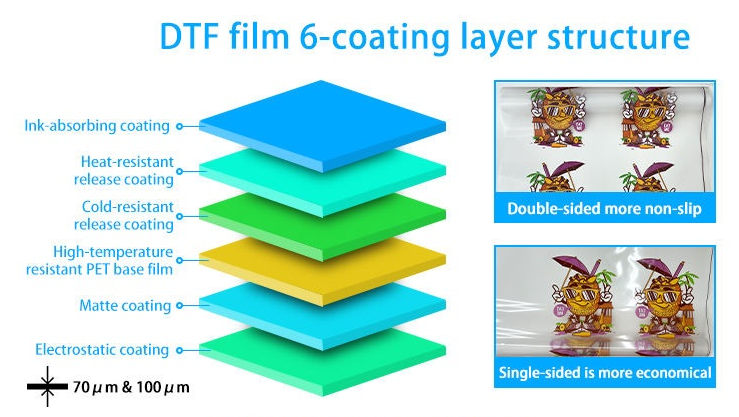
The overall thickness is not thick (75-100μm), it feels elastic, and can stretch with the fabric - for example, if printed on a hoodie, it won't crack even after long-term wear.
▶ UV DTF film: A "hardened strong player", suitable for hard objects
UV DTF film is more complex, it is a "double-layer AB film system", like a "sandwich":
• A film (printing layer): PET substrate coated with a "UV ink adsorption layer", after the ink is sprayed, it is instantly cured by a UV lamp (365-395nm wavelength);
• B film (transfer layer): with a layer of pressure-sensitive adhesive (similar to strong self-adhesive), no heating is required, it can be directly "cold pasted" onto hard objects.
High-end models also add a "crystal film", with a surface hardness of up to 2H (equivalent to the hardness of ordinary glass), it feels glossy and is scratch-resistant.
II. What's the difference in the process? It's about "heating or not"
Different structures lead to completely different printing processes for the two, and even the required equipment is different:
▶ DTF film: Requires "heating and drying", suitable for small batches
The process is a bit like "baking":
1. Use a DTF printer to spray ink (CMYK + white ink) onto the PET film;
2. Sprinkle hot melt adhesive powder and put it in a powder drying machine to dry;
3. Use a heat press (140-160°C) to press the film onto the fabric, after the adhesive powder melts, tear off the PET film and it's done.
The equipment cost is not high (3000-10000 US dollars), but there are many steps, suitable for small batch customization in studios (such as printing dozens of hoodies at a time).
▶ UV DTF film: "Print and dry immediately", higher efficiency
The process is like "fast food", no waiting:
1. The UV printer directly sprays ink onto the A film;
2. The built-in UV lamp cures the ink in 3 seconds (no need to wait for drying);
3. Cover with the B film and directly stick it onto hard objects (such as phone cases, glass), and it's ready to use after peeling off the film.
The equipment is a bit more expensive (8000-30000 US dollars), but it saves the "heating" step, suitable for large-scale production (such as printing hundreds of phone cases a day).

III. Key! Which scenarios should you choose which? (Performance + application comparison)
This part is the most practical, directly corresponding to your needs - first look at what you want to print, then choose the film:
▶ Choose DTF film: For "soft materials + need to be washed" scenarios
The core advantages of DTF film are "soft and washable":
• It can be stretched: The adhesive layer is soft and can be stretched to three times its original length without cracking, making it suitable for elastic fabrics (such as sweatshirts, yoga wear, and swimwear).
• It is washable: The hot melt adhesive bonds firmly with the fabric fibers, and the pattern will not fall off even after 10 or more washes.
• It is environmentally friendly: It has no solvent smell and meets textile environmental standards (for example, it is safe to print on clothes for babies).
Typical applications: Customized T-shirts, sweatshirt hats, canvas bags, mouse pads - in short, anything made of fabric, choosing DTF is usually a good choice.
However, it should be noted that it may fall off when applied to hard objects (such as plastic boxes), and it may fade if used outdoors for a long time.

▶ Choose UV DTF film: Identify scenarios that require "hard materials and durability"
The strong points of UV DTF film are "hard and durable":
• Super durable: The UV-cured ink forms a hard coating that can withstand 20,000 scratches (for example, it won't scratch even if used dail y on a phone case), is water-resistant and fade-resistant, and can last 3-5 years outdoors (up to 7 years with an additional protective film).
• High aesthetic level: It can create embossed and matte-glossy effects (for example, when printing trophies, the three-dimensional effect can be seen).
• Not picky about hard substrates: It can be applied to glass, metal, plastic, and ceramic, even curved surfaces (such as mugs and smartwatch bands).
Typical applications: Customized phone cases, metal nameplates, car interior stickers, crystal trophies - in short, anything hard, choosing UV DTF is usually a good choice.
However, it has the following disadvantages: It may curl when applied to soft fabrics (for example, it may crack when printed on sweatshirts), and there may be residue if the ink is not fully cured. Choose products that meet RoHS and FDA certifications.

IV. Cost & Environmental Impact: How to Choose Between Small Batch and Large Scale Production?
In addition to the application scenarios, cost is also an unavoidable factor:
|
Dimension |
DTF Film |
UV DTF Film |
|
Equipment cost |
Low (3,000 - 10,000 US dollars) |
High (8,000 - 30,000 US dollars) |
|
Material cost |
About 2986$ per ton (need to purchase hot melt adhesive powder) |
High (8,000 - 30,000 US dollars) Material cost About 2986$ per ton (need to purchase hot melt adhesive powder) |
|
Environmental friendliness |
No solvents, but PET film is difficult to degrade |
No VOCs, partially meets food contact standards |
In summary:
• If you are a personal studio and print dozens of sweatshirts at a time, choose DTF - the equipment is cheap and the initial investment is small.
• If you are a factory and produce phone cases and nameplates in large quantities, choose UV DTF - no heating is required, saving energy, and it is more cost-effective in the long run.
V. Summary: Three Steps to Choose the Right Printing Film
Finally, Here is a foolproof guide for your reference.:
1. Look at the substrate: Choose DTF for soft materials (such as fabric and knitted fabrics), and UV DTF for hard materials (such as plastic and metal).
2. Look at the application: Choose DTF for washable and fabric applications, and UV DTF for scratch-resistant and outdoor use.
3. Look at the batch size: Choose DTF for small batch trials, and UV DTF for large-scale production.