2026-03-10
How to Choose Ink? A Guide to Consumable Matching for Different Printing Methods – No More Mistakes
When it comes to printing, ink is the absolute core. Choose the right one, and you’ll get great printing results, a longer-lasting device, and lower consumable costs. Pick the wrong one, though, and you might end up with a clogged nozzle, faded patterns, or even a broken machine. Whether it’s for daily office printing, making your own cultural and creative gadgets, or running a printing business, choosing the wrong ink is a total waste of time and money.
Today, I’ll break down everything you need to know about matching ink with mainstream printing methods. From how each method works, what ink to use, what to look out for when choosing, to which scenarios they’re best for – I’ll cover it all in one go. After reading this, you’ll know exactly which consumables suit your printing needs.
Heat Sublimation/Heat Transfer Printing: Designed for Chemical Fiber and Coated Materials
Heat transfer (heat sublimation) printing has a huge advantage: the printed patterns fuse with the material, so they won’t fade or peel off. The principle is actually simple – use high temperature (180-220℃) to turn the ink directly from solid to gas, which seeps into the surface of the material and sets once it cools down. There are two types: direct printing and transfer paper printing, both specifically designed for chemical fiber fabrics and coated hard materials.
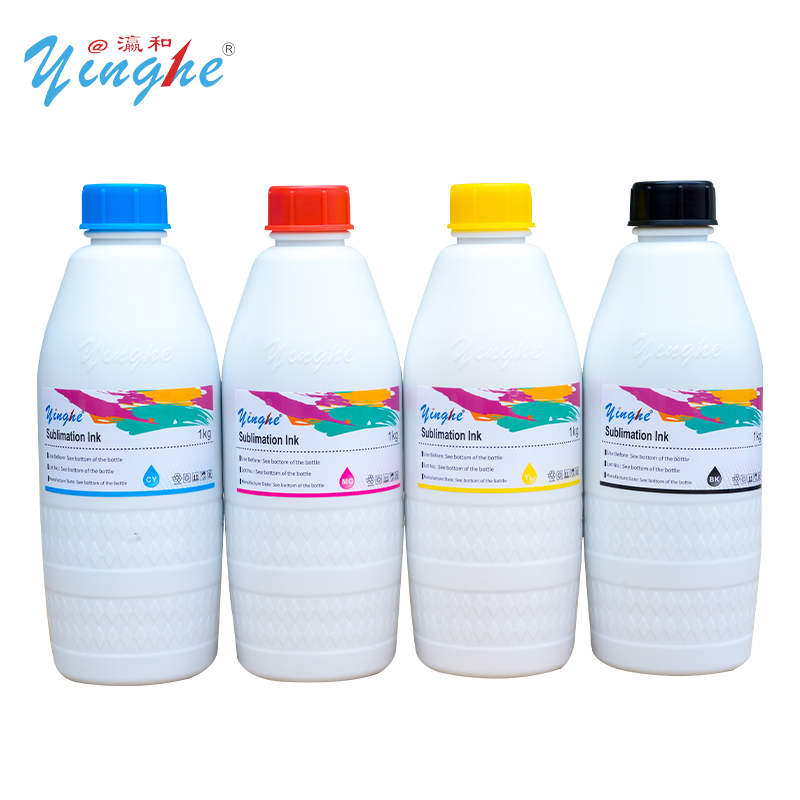
For this printing method, stick to water-based heat sublimation ink (also called disperse dye ink). It’s commonly used with piezoelectric printers, has extremely fine ink particles, and works with both industrial-grade and desktop-grade piezoelectric nozzles.
Remember these points when choosing: ① Match the nozzle – for piezoelectric 5th/7th generation nozzles, choose ink with an average particle diameter of less than 0.5μm, otherwise it’s easy to get misprints or clogged nozzles; ② Check core performance – prioritize ink with high transfer rate (less residual ink means more savings), wash fastness of 4-5 levels, and strong light resistance to ensure patterns last long; ③ Don’t use the wrong materials – it’s only suitable for polyester/chemical fiber fabrics and coated hard materials like ceramics, metals, glass, and PVC. Never use it on cotton, linen, silk, or nylon; ④ Don’t mix inks – mixing it with original or other brands’ ink can cause chemical reactions. Always clean the pipelines thoroughly with a special cleaning fluid before changing inks.
It’s perfect for printing on chemical fiber T-shirts, curtains, and scarves, customizing small gifts like water cups, pillows, and mouse pads, as well as making advertising stands and ceramic/metal decorations – whether it’s for personalized customization or small-batch production.
Inkjet Printing: The Versatile Method – Choose Ink Based on Your Needs
Inkjet printing is the most commonly used method for civilian and commercial purposes today. The principle is that the nozzle sprays ink droplets onto the material, which are fixed by absorption or penetration. It can print on paper, fabrics, and hard materials, and there are more types of ink than any other method. The key is to choose ink accurately based on your purpose and the material you’re printing on – don’t just pick any random ink.
Daily Office/Home Document Printing: Dye Ink – Best Value for Money
Ordinary dye ink is all you need. It’s cheap, flows smoothly, has decent color reproduction, dries quickly, and doesn’t smudge paper. It works with regular printing paper and photo paper, and is more than enough for printing documents and simple images. The only downside is that it’s not very light-resistant or waterproof – printed items will fade if left in the sun for too long. If you don’t need to keep them for a long time, this is the way to go.
High-Definition Photo/Image Output: Pigment Ink – Long-Lasting
For professional photo printing, choose nano-pigment ink or special photo dye ink. Pigment ink is highly waterproof, light-resistant, and anti-oxidant – printed photos can last for a long time without fading, which is why photo studios and photography enthusiasts prefer it. Special photo dye ink has the advantage of a wide color range and natural transitions, which can restore the delicate texture of photos, making it suitable for those who pursue high-definition results. A reminder: pigment ink particles are slightly larger, so they’re prone to clogging nozzles. You need to turn on the printer regularly for maintenance to keep the nozzles moist.
Outdoor Advertising/Industrial Printing: Solvent/UV Ink – Weather-Resistant
The most important thing for outdoor printing is water resistance, sun resistance, and strong adhesion. The three main types are weak solvent ink, eco-solvent ink, and UV-curable ink. Weak solvent ink is used with outdoor piezoelectric printers and can print on light banners, car stickers, and adhesive films. UV-curable ink is a must for industrial printing – it dries instantly when exposed to ultraviolet light, can be printed directly on uncoated glass, metal, and wood without the need for lamination, and is compatible with more special hard materials. A small tip: solvent-based ink has a smell and is volatile, so it must be used in a well-ventilated area.
Direct-to-Garment (DTG) Printing: Exclusive for Cotton – Use Textile Ink
If you want to print on cotton, linen, or blended fabrics, heat sublimation ink won’t work – you need water-based textile pigment ink (DTG Ink), which is exclusive to cotton. This ink has strong adhesion and elasticity, so printed patterns won’t crack easily. However, it needs to be used with fabric pre-treatment fluid, and is great for personalized customization of cotton T-shirts, canvas bags, etc. Unlike heat sublimation ink, which “seeps into the material to set color”, DTG ink adheres directly to the surface of the fabric.
Also, a general rule for inkjet printing: the type of nozzle determines which ink you can use. Piezoelectric nozzles require low-viscosity, fine-particle ink, while thermal bubble nozzles require special dye/pigment ink – never mix them. When changing ink brands or types, make sure to thoroughly clean the pipelines and nozzles.
Laser Printing: Dry Printing – More Efficient with Toner
Unlike ordinary inkjet printing, laser printing is a dry printing method that doesn’t use liquid ink – its core consumable is toner. The principle is to use laser scanning to charge the photosensitive drum, which attracts toner, and then fuse the toner onto the material with high temperature and pressure. It’s the best choice for high-volume, high-frequency printing needs.
When choosing toner, there are black and color options, as well as original, compatible, and bulk types. The core point is: match the model of your printer/copier. If the toner cartridge is incompatible, it will leak toner and result in blurry prints. You also need to check the fineness of the toner particles – the finer the particles, the higher the printing resolution, and it can avoid scratching the photosensitive drum. For daily office use, compatible toner with good value for money is sufficient. For professional graphic output, it’s recommended to choose original toner to ensure consistent color. For outdoor printing, choose waterproof and light-resistant toner; for thick paper/cardboard, choose toner with a high melting point to prevent it from falling off.
Laser printing is suitable for daily office document printing, high-speed batch printing, and black-and-white/color quick printing in graphic shops. It can print on regular paper, coated paper, and thick cardboard. The downside is that it can’t print on textiles or soft materials.
Its advantages are obvious: fast printing speed, low per-page consumable cost, light-resistant and waterproof printed items, and no need to maintain nozzles. It’s especially suitable for office areas and commercial scenarios with high printing volume.
Screen Printing: Industrial Batch Printing – Most Adhesive Ink
Screen printing is the mainstream for industrial batch printing. The principle is to scrape ink through the mesh of a screen plate onto the material, which is a type of “stencil printing”. The ink adheres directly to the material surface, making it extremely strong. It can print on almost all materials – if you need to print large patterns with strong adhesion, this is the right choice.
When choosing screen printing ink, you must strictly follow the material you’re printing on: water-based textile ink for cotton fabrics, disperse ink for chemical fibers, high-temperature curing ink for glass/metal, self-drying plastic ink for plastics, and special paper ink for paper. There are also process considerations: choose low-viscosity, easy-to-scrape ink for manual screen printing, and smooth-flowing, fast-drying ink for machine screen printing. For scenarios with high environmental requirements, such as food packaging and children’s products, be sure to choose food-grade, benzene-free eco-friendly ink that meets national environmental standards.
It can be used for batch clothing printing, packaging printing, poster making, signs, and cultural and creative product customization. It works with cotton, plastic, glass, metal, and other materials – the larger the printing volume, the lower the per-unit consumable cost.
A small tip: screen printing ink needs to be used with squeegees and screen plates. Different inks have different drying methods – some dry naturally, some need high-temperature baking, and some need UV curing, so you need to match them with corresponding equipment.
Niche Printing Methods: For Special Scenarios – Choose Consumables as Needed
In addition to the mainstream methods above, there are some niche printing methods suitable for specific scenarios, with special requirements for consumables. Let’s briefly talk about them:
-
Heat Transfer Film Printing (Hot Stamping): No liquid ink is needed – the core is heat transfer film. High temperature is used to transfer the ink on the film to the material. It’s suitable for printing small logos and text on plastic, metal, and leather. Just choose the corresponding transfer film according to the material you’re printing on.
-
3D Printing: It also doesn’t use traditional ink – the core consumables are 3D printing filaments (PLA/ABS/PETG) and photosensitive resin. For desktop printers, choose PLA filaments, which are easy to print and eco-friendly. For industrial-grade printers, choose ABS/PETG, which has high hardness and heat resistance. For UV-curable 3D printers, you must use special photosensitive resin.
Universal for All Printing Methods: 5 Core Principles for Choosing Ink – Avoid 90% of Mistakes
No matter which printing method you use, remember these 5 principles, and you’ll rarely go wrong when choosing ink. They’ll help you balance effect and cost, and protect your device:
1. Determine the Printing Method First, Then Choose Ink
Choose the printing method based on your core needs: for personalized chemical fiber customization, choose heat sublimation; for cotton printing, choose DTG direct-to-garment; for daily office use, choose laser or inkjet dye ink; for outdoor advertising, choose UV/weak solvent ink; for industrial batch printing, choose screen printing. This avoids choosing the wrong consumables from the start.
2. Equipment and Materials Must Match the Ink
The type and brand model of the printer’s nozzle directly determine whether you can use a certain ink. The wrong ink will not only lead to poor printing results but may also directly damage the nozzle. The adhesion and color-fixing method of the ink must match the material you’re printing on. For example, choose UV ink for uncoated hard materials, DTG ink for cotton, and heat sublimation ink for chemical fibers. No matter how expensive the ink is, it won’t produce good results if it doesn’t match the material.
3. Find a Balance Between Cost and Effect
For home use with low printing frequency, choose cost-effective compatible ink to meet basic needs. For professional output and industrial-grade printing, it’s recommended to choose original or high-end special ink to ensure consistent color, stable printing, and more durable finished products. For batch printing, prioritize large-capacity ink (1L/5L/20L) to effectively reduce the per-unit consumable cost.
4. Prioritize Ink Quality and Environmental Friendliness
Prioritize ink with formal certifications, such as ISO9001/14001, RoHS, and QC080000. This type of ink has no harmful components, low volatility, stable printing effect, and no pungent smell or harmful gas emissions that can harm your health. This is especially important for printing food-contact items, children’s products, or printing indoors. Inferior ink is prone to clogging nozzles and corroding equipment – it may seem cheap, but the cost of repairing the equipment and replacing parts later is much higher.
5. Don’t Ignore Storage and Maintenance
The storage and maintenance of ink directly affect its service life and printing effect: water-based ink (heat sublimation, dye, pigment) should be stored in an environment of 10-35℃, used within 1 month after opening, and the printer should be turned on regularly to maintain the nozzles. Solvent/UV ink should be stored in a sealed container and used in a well-ventilated area. Toner should be stored in a dry place to avoid moisture and clumping.
Final Words
Choosing ink is never about choosing the most expensive one – it’s about choosing the one that’s right for you. Different printing methods, equipment models, printed materials, and even different usage scenarios require different ink selection strategies.
I hope this guide helps you sort out your ideas, avoid mistakes when choosing ink, achieve the desired printing effect every time, protect your printing equipment, and spend less on consumables and maintenance. If you still don’t know which ink to choose for a specific printing scenario, refer to this guide and match it with your needs one by one – you’ll always find the most suitable one.