
2026-07-23
List of Components for Embroidery Studio: Besides the machine itself, what other consumable accessories are needed?
When starting to assemble an embroidery studio or store, people often encounter this situation: After purchasing the embroidery machine and preparing for installation, it is discovered that some tools are actually missing during the installation process. When ready to test samples after installation, it is found that a certain accessory is lacking. And when the accessories are prepared, it is discovered that a certain consumable is missing. The shortage of tools, accessories, and consumables greatly affects the installation and debugging of the machine, sample testing, and also affects the progress of accepting orders, wasting a lot of time.
Today, we will tell you what consumables, accessories, and consumables an embroidery studio needs in addition to the embroidery machine. You can refer to the requirements to prepare accordingly to ensure the smooth progress of embroidery work.
H2: Why do embroidery machines need to be equipped with all the necessary complete sets of accessories?
Most embroidery machine manufacturers will provide a basic set of accessories when the machine is manufactured, but the dealers will not include the complete set of accessories when selling. Or if you purchase second-hand embroidery equipment, there will be no accessories at all.
When you complete the necessary fixtures, tools, and consumables, the operation of the embroidery machine will be less prone to failures. The machine can operate stably, and the embroidery products will be smooth, fine, and with regular stitches. Only then can the embroidery machine produce high-quality finished products.
If the accessories and consumables used do not match, during the embroidery process, the stitches are prone to jumping and breaking, the fabric wrinkles and shifts, the stitches are messy, and the patterns are blurry; when processing irregular fabrics such as hats and sleeves, it will directly fail and shift. In terms of the appearance and quality of the embroidery products, they will be very poor.
Therefore, when the embroidery machine is actually used for embroidery, all the tools, fixtures, and consumables for a certain type of embroidery need to be fully equipped. Only then can the embroidery process be reduced of faults and high-quality products be produced.
H2: What accessories and consumables are needed for embroidery studios and embroidery stores
In general, the tools, accessories, and consumables needed by embroidery studios and embroidery stores can be divided into three major categories. These three types of materials correspond to the three core links of starting production, quality control, and equipment maintenance.
The first category is essential consumables, such as embroidery thread, backing paper, and machine needles, which are necessary for starting the embroidery project and are the most frequently used and consumed;
The second category is frame fixtures and embroidery accessories, used to fix the fabric and shape the pattern, directly determining the precision of the finished product and the range of embroidery that can be done;
The third category is maintenance tools and auxiliary equipment, responsible for daily debugging, maintenance, and fault detection, which can effectively extend the service life of the equipment.
H3: I. Essential Consumables
These consumables are materials that are consumed during each embroidery. Without them, the machine cannot be started normally, or some are missing, which will greatly reduce the quality of the embroidered products. They need to be stocked in large quantities and are the core focus of the first batch purchase.
H4: Embroidery-specific embroidery thread
The quality of the embroidery thread directly determines the glossiness, flatness, and durability of the embroidery pattern, and is also the core key to reducing stitch jumping and breaking. The polyester embroidery thread: the most cost-effective commercial main material, with strong toughness,Not prone to disconnection, high color fastness, and wash resistance, suitable for various regular fabrics such as cotton, denim, and canvas, suitable for logo embroidery, custom clothing, and small batch orders, is the basic material commonly kept by small stores.
Artificial silk embroidery thread: with a smooth and fine surface gloss, high embroidery surface texture, suitable for high-end gift customization, fashion embroidery, and exquisite small flower patterns, those who pursue high-quality product effects can be prioritized to select.
H4: Embroidery backing / Stabilizing backing
Backing paper is the key to preventing fabric deformation, wrinkling, and shifting. Different fabrics must be paired with corresponding backing paper to ensure the finished product is smooth and neat.
• Hand撕 backing: suitable for thick fabrics such as denim, sweatshirts, and canvas bags, can be removed directly after embroidery, clean and without residue, convenient to operate.
• Cutting backing: specially designed for T-shirts, knitted fabrics, and elastic fabrics, effectively prevents fabric stretching and deformation, with stronger fixation, ensuring the embroidery on elastic fabrics is flat without distortion.
• Water-soluble backing: suitable for ultra-thin fabrics, lace, and镂空 embroidery, dissolves completely when exposed to water, without any residue, solving the problem of lightness and thinness of fabric embroidery and deformation.
Hot melt backing: suitable for small area logo embroidery, difficult-to-fix irregular fabrics, fixed by high-temperature hot melting, high adhesion, and the finished product is smooth and exquisite.
H4: Embroidery machine needles
The machine needle is a wear-prone accessory. Over time, high-speed embroidery will cause wear, bending, and broken stitches. Therefore, the machine needle is a consumable that needs to be frequently replaced and stocked in large quantities.
Different fabrics require corresponding needle sizes, precise matching can reduce stitch jumping and breaking problems:
• 75/11 machine needle: suitable for thin T-shirts, knitted fabrics, and chiffon fabrics. • 90/14 needle: Suitable for cotton fabrics, canvas, regular clothing, and general scenarios
• 100/16 needle: Suitable for denim, leather, thick fabrics and other heavy materials
It is recommended to always keep a mixed specification needle box on hand for emergency replacement, to avoid downtime caused by broken needles and to ensure smooth production.
H4: Needle core and bottom thread
The bottom thread is the foundation for embroidery formation. Many beginners frequently encounter problems such as thread jamming, missed stitches, and incomplete patterns due to neglecting the preparation of the needle core and bottom thread. Preparing multiple bottom threads in advance and using them in batches can significantly improve daily embroidery efficiency and reduce downtime for troubleshooting.
It is recommended to choose the original adapter needle core for the model.
H3: Frame, fixtures and fixed accessories
Without suitable or compatible fixtures, the fabric cannot be stabilized, leading to problems such as uneven stitch formation, fabric wrinkling, and deformation. Various frames and specialized fixtures, with different fixtures suitable for different types of embroidery, enhance the core of product qualification rate.
H4: Standard embroidery frame
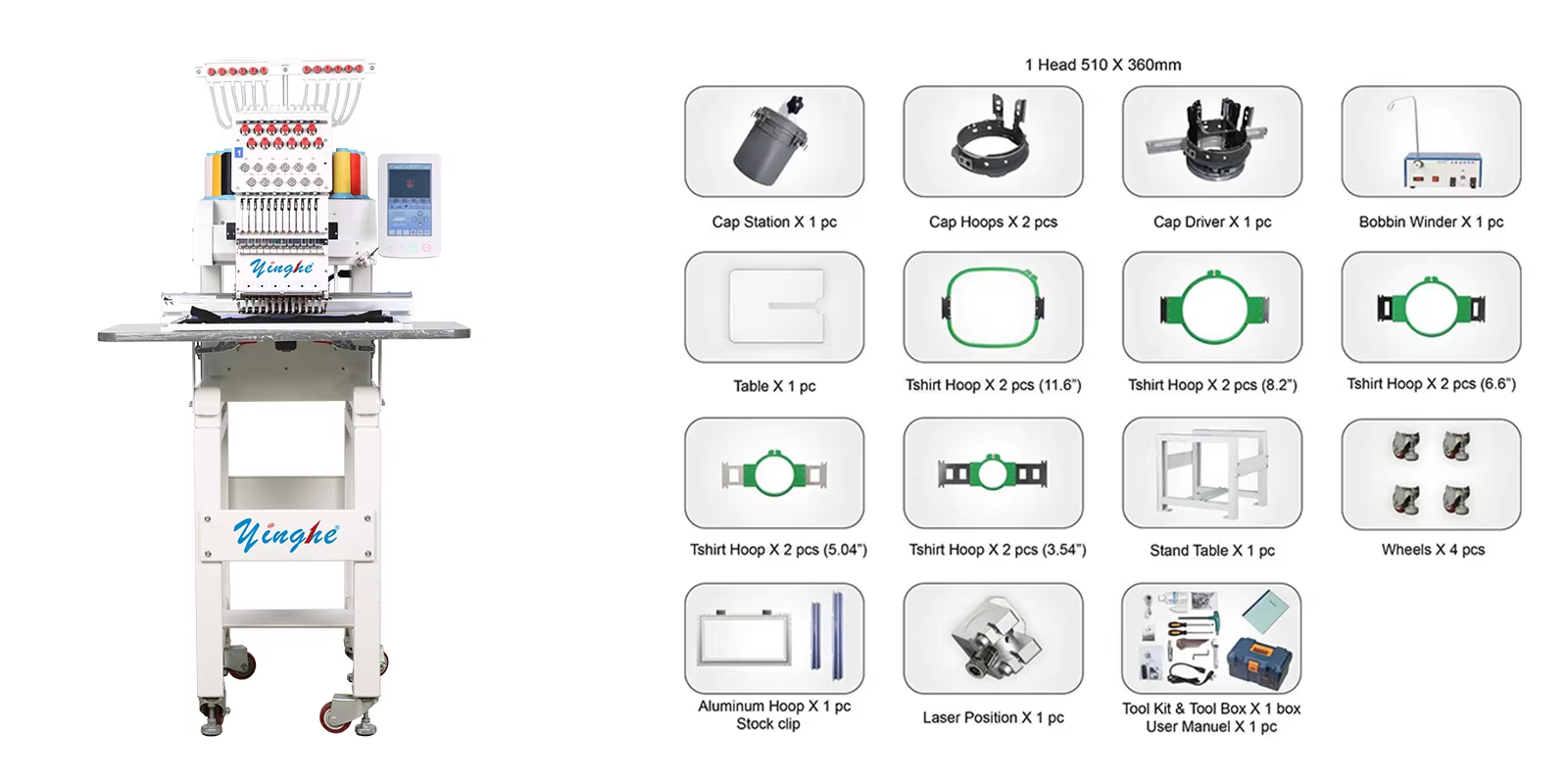
Desktop embroidery machines support various sizes of frames, which precisely adapt to different pattern areas: Small-sized frames are suitable for text, small logos, and mini-pattern embroidery, while large-sized frames can meet the needs of large-area patterns, full embroidery, and complete pattern production.
Newbies are advised to clarify their main business and requirements. In the initial stage, it is not necessary to have all sizes fully equipped. Keeping 2-3 common specifications on hand can cover 90% of text, logo, and small-pattern custom orders, avoiding waste of funds and inventory.
H4: Specialized custom fixtures
To break through the limitations of flat fabrics and expand diversified order-taking business, specialized fixtures are essential upgrade accessories that can easily unlock multi-category embroidery:
• Headwear embroidery fixture: Specifically designed for curved embroidery on baseball caps and beanie hats, solving the problem of uneven stitch formation on curved fabrics.
• Clothing fixture: Supports direct embroidery on sleeves, collars, and trouser cuffs, eliminating the need to cut the garment and maintaining the integrity of the custom order.
• Specialized fixtures for small items: Suitable for canvas bags, shoes, keychains, and small fabric cultural products, enriching the customization categories.
H4: Auxiliary fixation tools
Embroidery-specific tape and double-sided fixing glue can firmly fix ultra-thin and ultra-soft fabrics, preventing fabric displacement and wrinkling during high-speed machine operation, significantly reducing the defect rate and improving product quality.
H3: Maintenance and practical tools
H4: Basic tool kit
Hex key wrench, screwdriver, special wire-cutting scissors, and tweezers are used for daily machine debugging, cleaning wire ends, replacing accessories, and fine-tuning equipment parameters. They are the basic tools for daily operations.
H4: Machine maintenance consumables
Embroidery machine-specific lubricating oil, cleaning brushes, and air blowers are used for daily dust removal, guide rail lubrication, and machine core maintenance. Regular maintenance can significantly reduce machine failure rates, avoid jamming, abnormal sounds, and accuracy deviations, and reduce high-cost after-sales maintenance expenses.