
The Ultimate Guide to Heat Transfer Machines: From Theory to Practice
The heat press machine is a tool for DIY clothing customization and personalized gift production. Whether you want to add custom designs to T-shirts, create team apparel, or start a custom clothing business, understanding heat press machines is essential. This article will introduce various types of heat press machines, their specifications, suitable applications, and the types of businesses they are best suited for. It provides a comprehensive guide to heat press machines, covering their functions, selection criteria, usage tips, and purchasing information.
What is a heat press?
Heat press machine is a device that uses heat and pressure to transfer designs from a transfer film onto various materials. Suitable materials for heat transfer include cotton (white, light-colored, or black fabric), polyester, canvas, leather/faux leather, smooth and flat wood surfaces, coated metal surfaces, ceramic, glass, and more. The working principle: By precisely controlling temperature, pressure, and time, a heat press ensures that the transfer material (such as vinyl or sublimation ink) adheres permanently to the substrate. Unlike a traditional iron, a heat press distributes heat evenly and maintains consistent pressure, resulting in professional-quality results.
What does a heat press do?
Heat transfer machines are primarily used for:
inyl transfers: Heat-pressing cut vinyl designs onto garments.
Sublimation transfers: Transferring designs printed with sublimation ink onto polyester or coated items.
Heat transfer paper: Transferring inkjet or laser-printed designs onto light-colored garments.
Other applications: Transferring glitter, rhinestones, and more.
It's suitable for a variety of products, including T-shirts, hats, mugs, mouse pads, and ceramic plates.
What types of heat transfer machine are there?
1. Combo Press / All-in-One Press (Multi-function Transfer Machine)
This machine is based on a single mainframe, allowing for multiple functions by replacing different press platen attachments. It's an ideal choice for saving space and money.
How it works: A powerful mainframe (usually based on a swing-out mechanism) is equipped with a set of quickly removable and interchangeable press platen attachments, such as a standard flatbed, cap press, and cup press kit.
Advantages:
Multiple uses in one machine: You only need to purchase one mainframe and several attachments to process a variety of products, such as T-shirts, hats, and cups, offering excellent value.
Space savings: No need to purchase three separate machines.
Disadvantages: Changing attachments takes time, which can be cumbersome when batching different products.
Attachments must be purchased separately, resulting in a potentially high initial investment.
Suitable for: Small studios, entrepreneurs, or users who need to process a variety of products but have limited space.
2. Swing-Away / Clamshell Heat Press
This is the most classic and common type, named for its operation, which resembles a flip phone or clamshell.
How it works: The upper press platen is connected by a hinge mechanism and swings open completely upward and sideways like a door.
Advantages:
Easy to operate: The fully open press area makes it easy to place the substrate (such as a T-shirt) and position the design, making it particularly suitable for large or heavy items.
Even pressure: Generally provides very strong and even pressure.
Space-saving: Because the press platen presses vertically, no space is required directly in front of the machine.
Disadvantages:
Can lack space for very thick, three-dimensional objects (such as thick sneakers).
Suitable for: Almost all flat items, especially T-shirts, canvas bags, mouse pads, bed sheets, tablecloths, etc. The small size of the hea press is suitable for beginners and the most versatile choice. The large size is suitable for small factories and small companies.
3.cap press
A cap press is a specialized machine designed specifically for transferring designs onto baseball caps and peaked caps.
How it works: It features a curved lower platen that perfectly conforms to the cap's curves. The upper platen is also a corresponding curved heating platen, ensuring even coverage of the cap's brim during pressing.
Advantages:
Professional fit: The curved platen ensures uniform heat and pressure across the cap's curved surface, something a flatbed press cannot achieve.
Easy to operate: A dedicated clamp is typically used to secure the cap to prevent movement.
Disadvantages:
Its limited functionality means it can only be used on caps.
Suitable for: Transferring designs onto baseball caps, five-panel caps, and other caps.
4. Pen Press Machine
Pen heat transfer machines are highly specialized equipment in the heat transfer industry, specifically designed for transferring designs onto cylindrical, slender objects. Primarily, they are used for various pens (such as ballpoint pens, fountain pens, and styluses), but are also suitable for other similarly shaped small items.
Advantages: Professional and Efficient: Designed specifically for pens, they offer high transfer efficiency and excellent results, resulting in seamless, professional-looking finished products.
Easy to Use: They typically come with a dedicated fixture for easy placement and placement, ensuring precise positioning.
High Success Rate: The V-groove design perfectly eliminates the problems of misalignment, wrinkles, and noticeable seams that can often occur when transferring cylindrical objects.
Disadvantages: Single Functionality: They are primarily suitable for pens within a specific diameter range and a very limited number of similarly shaped items, making them difficult to versatility. It cannot handle flat items of clothing or cups.
Main Applications:Pen press machines are primarily used for customizing promotional pens, personalized gift pens, and other small cylindrical items. In addition to pens, testing has shown that they are also generally suitable for transferring other objects of similar diameters, such as small flashlights, lipstick tubes, certain e-cigarette models, and slender instrument handles
5、Drawer Style Heat Press
This type of machine is often combined with a mug press and is a professional choice for transferring mugs.
How it works: The bottom of the machine has a drawer-like slide for placing the mug. When the drawer is closed, a heating sleeve wrapped around the mug tightens and heats, applying even pressure and heat to the mug.
Advantages:
Designed specifically for mugs: It fits perfectly to cylindrical mugs, ensuring seamless transfers.
Safe and stable: The mug is securely fixed, preventing it from sliding and causing transfer failure.
Disadvantages: Limited functionality, typically suitable for mugs only.
Suitable for: Suitable for transferring mugs and travel mugs of various sizes
6.Pneumatic heat press machine
Pneumatic heat transfer machines use compressed air (pneumatic system) as power, using a cylinder to drive the upper platen to open and close, applying pressure to the transfer material. The operator simply presses a button, and the machine automatically completes the process of pressing down, maintaining pressure, and raising the platen.
Key Features and Benefits
Extremely uniform and adjustable pressure: This is the greatest advantage of pneumatic presses. Pressure is controlled by an air pressure system and can be precisely set on the control panel (e.g., 40-100 psi). Once set, every product is precisely pressed, eliminating variations in pressure due to operator strength.
Highly repeatable and consistent: The fully automated pressing cycle (press down - time - lift) ensures that the three key parameters of time, temperature, and pressure are identical for every transfer. This is crucial for large-scale batch production, ensuring consistent quality from product to product.
Significantly reduces operator effort: Operators no longer need to exert force by pressing down or turning a handle; they simply place the substrate and press a button. This significantly reduces physical exertion and improves work efficiency, making it particularly suitable for long, high-intensity production environments. Better Transfer Quality: Extremely uniform pressure ensures even heat distribution, making it far superior to manual presses for transferring large-area designs, hard objects (such as license plates and phone cases), or pressure-sensitive materials (such as some glittery vinyls), effectively avoiding areas of under-pressing or blurred images.
Disadvantages and Considerations
Higher Cost: The purchase price of a pneumatic press is significantly higher than that of a manual press of the same size.
Additional Equipment: An air compressor must be purchased, increasing both the initial investment and the required floor space.
More Complex Maintenance: Regular, simple maintenance on the pneumatic system is required, such as checking the air compressor and draining the water filter.
Flexibility: While production efficiency and consistency are unmatched, the setup process is slightly more complex than with a manual press. This makes it more suitable for long-term production runs of similar products, rather than frequent, small-batch changes.
Target Users: Pneumatic heat transfer machines are not designed for the average hobbyist. Their target users are very specific:
1.Large-scale garment factories that produce hundreds or even thousands of printed garments daily.
2.Professional promotional product manufacturers: mass-produced mouse pads, coasters, metal license plates, and more.
3.Custom businesses with stable, large orders: demand absolute product consistency and maximum efficiency to meet customer needs.
4.Factories working with rigid substrates: specializing in pressing phone cases, ceramic tiles, and wood panel prints, for example. These materials require strong and uniform pressure for a good transfer.
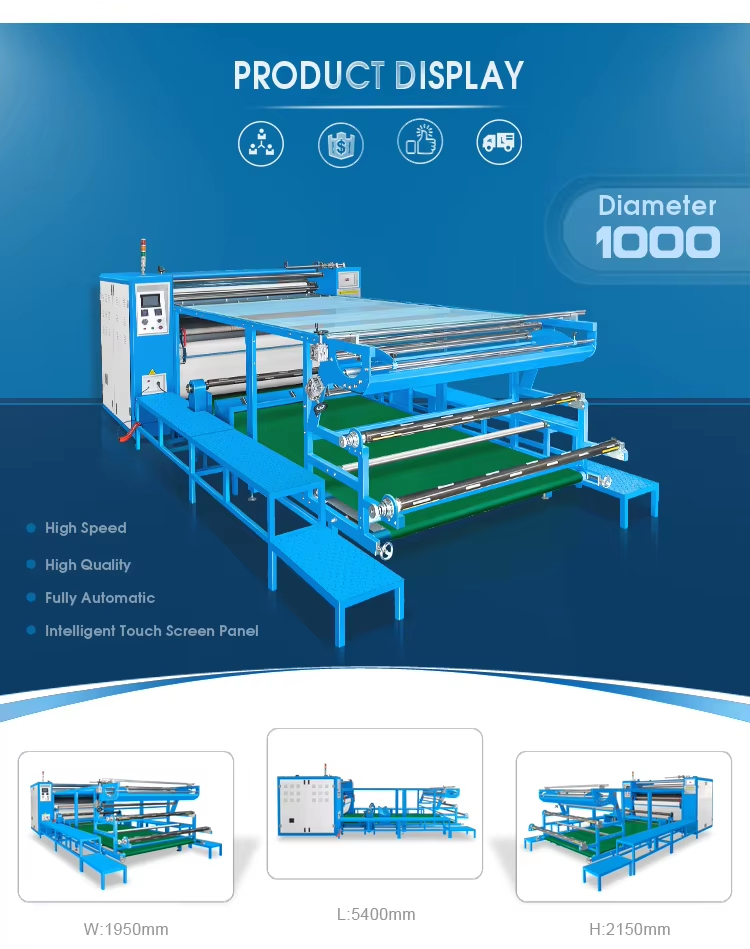
7.Roll heat transfer machine
A roller heat transfer machine uses a continuously heated roller as the upper heating element, coupled with a high-temperature-resistant conveyor belt. The garment to be transferred is placed flat on the conveyor belt and conveyed at a constant speed through the gap between the heated roller and the lower platen. This continuous movement completes the heating and pressing process.
This machine's key feature is continuous operation, unlike the "press and stop" cycle of a flatbed press.
Core Working Principle
1). Infeed: The operator places the substrate (such as a roll of cut T-shirts or a flat, full-length T-shirt) onto the conveyor belt at the entrance.
2). Heating and Pressing: The conveyor belt smoothly feeds the substrate into the machine, passing it through the nip point between the heated roller and the lower platen. This nip provides pressure, while the roller provides heat.
3). Output: The substrate exits the other side of the machine, completing the transfer process. The operator can immediately remove the finished product and simultaneously place the next item to be printed, achieving streamlined operatio
Main Types
1). Single Roller: The most common, basic model features a single heated roller for single-sided transfers.
2). Dual Roller: Equipped with two heated rollers and two conveyor belts, it can transfer to both the front and back of a garment simultaneously, doubling efficiency. For example, it can print both the front and back of a T-shirt in one go.
Main Features and Advantages
1). Unparalleled Production Efficiency: This is the core advantage of a roller-type transfer machine. It eliminates the cycle time of opening, closing, cooling, and reheating required by flatbed transfer machines, enabling true continuous production. With skilled operation, output can reach over 500-1000 pieces per hour, far exceeding the capabilities of flatbed transfer machines.
2). Perfect Continuous Pattern Transfer: This transfer machine is ideal for transferring oversized patterns, full-face prints, or continuous patterns on rolls. The rolling pressure of the rollers seamlessly connects the pattern, eliminating the seams or color variations that can occur with multiple impressions on flatbed transfer machines.
3). Consistency and Uniformity: Since the roller maintains a constant temperature and pressure, each product is subjected to identical heat and pressure conditions as it passes through, ensuring extremely high consistency.
4). Better Suitability for Specific Materials: When processing certain materials that are more sensitive to continuous heat (such as certain thermal transfer papers or coatings), the roller embossing method can sometimes provide better results.
5). Labor Savings: Easy to implement assembly line operations. One person is responsible for placing the products, while another is responsible for receiving and quality inspection. This clear division of labor significantly improves overall output.
Disadvantages and Considerations:
1. Extremely High Cost: Roller heat transfer machines are often several times, or even dozens of times, more expensive than high-end flatbed machines, requiring a significant investment for large factories.
2. Complex Setup and Adjustment: Temperature, pressure, and conveyor speed (dwell time is controlled by speed) require precise matching and adjustment, requiring higher operator skills.
3. Low Flexibility:
1) Not suitable for small-batch, high-mix production. Changing a pattern or product type requires re-adjusting machine parameters, which is time-consuming.
2) Unable to process three-dimensional or rigid items such as cups, hats, and phone cases. They are designed for flat or flexible materials such as cut pieces (T-shirt fronts and backs), ready-made garments, flags, and rolls.
4. Large Footprint: The machine's length requires a larger production area.
Applicable Scenarios and Users Roller heat transfer machines are highly specialized, industrial production tools with a very specific target audience:
Large-scale garment printing factories: OEMs for global brands, requiring daily production of thousands of printed garments. Large-scale promotional product manufacturers: These companies accept large-scale printing orders, such as event t-shirts and corporate uniforms.
Textile processors: These companies perform continuous transfer printing on rolls of fabric or other flexible materials.
What is the time and temperature for thermal transfer?
For metal material board, the heating temperature should be approx. 170-200℃,the heating time around 60 seconds; For ceramic board, the heating temperature should be approx. 200-220℃,the heating time around 60 seconds; For the fabric, the heating temperature should be approx. 120-140℃,the heating time around 5-10 seconds.
Please take the below information for example:
Thermal Sublimation Printing Time and Temperature |
||||
| Article | Printing Material | Temperature ( ℃) | Time (second) | Remark |
| 1.Ceramic | Sublimation ink, normal photo print paper (or sublimation paper) | 220 | 60 |
1. Mirror print the picture 2. Count the time when reach constant temperature 3. Stick the picture on the ceramic properly 4. Put the ceramic on the holder horizontally 5. Adjust low pressure to avoid broken of the ceramic |
| 2. Pearl Metal Board | Sublimation ink, normal photo print paper (or sublimation paper) | 180 | 60 |
1. Mirror print the picture 2. Count the time when reach constant temperature 3. The temperature should not be too high 4. Tear away the film on the cover before heat transferring and then put the pearl metal board on the holder horizontally 5. Adjust high pressure |
| 3. Metal Catch Lock | Sublimation ink, normal photo print paper (or sublimation paper) | 180 | 60 |
1. Mirror print the picture 2. Count the time when reach constant temperature 3. Stick the picture on it as close as you can 4. Tear away the film on the cover before heat transferring 5. Adjust high pressure |
| 4. Half Cotton Light Color T-shirt | Sublimation ink, normal photo print paper (or sublimation paper) | 180-190 | 120-130 |
1. Mirror print the picture 2. Count the time when reach constant temperature 3. Only for light color, half cotton T-shirt 4. High pressure |
| 5. Half Cotton Dark Color T-shirt | Sublimation ink, normal photo print paper (or sublimation paper) | 180-190 | 120-130 |
1. Print the picture 2. Count the time when reach constant temperature 3. Only for dark color, half cotton T-shirt 4. High pressure |
| 6. Pure Cotton Light Color T-shirt | Sublimation paper, normal ink | 180-190 | 30 |
1. Mirror print the picture 2. Count the time when reach constant temperature 3. Only for pure cotton Light Color T-shirt 4. High pressure |
| 7. Pure Cotton Dark Color T-shirt | Sublimation paper, normal ink | 180-190 | 30 |
1. Print the picture 2. Count the time when reach constant temperature 3. Only for pure cotton Dark Color T-shirt 4. High pressure |
| 8. Shell Necklace Ring | Sublimation ink, normal photo print paper (or sublimation paper) | 180 | 60 |
1. Mirror print the picture 2. Count the time when reach constant temperature 3. Stick the picture on it as close as you can 4. High pressure |
| 9.Imitative Ceramic Necklace Ring | Sublimation ink, normal photo print paper (or sublimation paper) | 180 | 60 |
1. Mirror print the picture 2. Count the time when reach constant temperature 3. Stick the picture it as close as you can 4. High pressure |
Conclusion:
What type of products will I primarily use this machine for? (T-shirts? Hats? Mugs?)
What is the scale of my business? (Is it a hobby, or a full-time business? What is my expected daily production volume?)
What is my available workspace and budget?
What are my future business development plans? (What new products do I plan to add?)
Final recommendation: For most startups and small businesses, a mid-sized (e.g., 15x15 or 16x20 inch), reliable, and temperature-controlled digital flatbed heat press is the most practical and cost-effective choice. It's sufficient to help you launch your business, test the market, and gain practical experience to truly understand your needs, thus laying a solid foundation for future upgrades or additional equipment. Remember, what's best for you is the best choice.