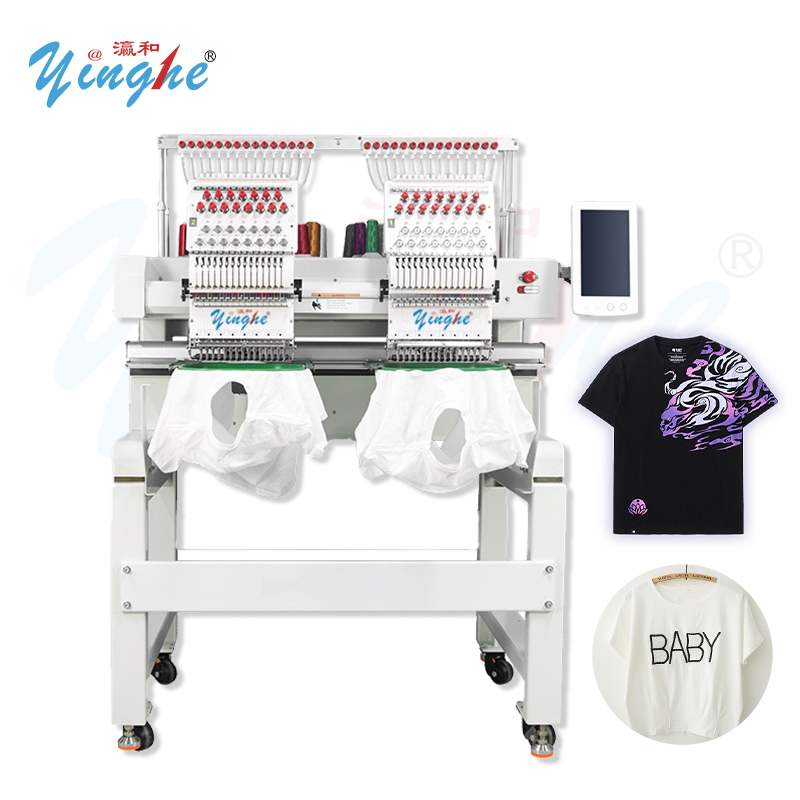

What is the backing material for a computerized embroidery machine
What is the backing material for a computerized embroidery machine?
In the computerized embroidery process, "embroidery stabilizer" is a type of professional embroidery consumable used to assist in fixing and stabilizing the fabric structure.
Many users who are new to computerized embroidery machines usually focus on the needle count, speed, frame size, and thread selection of the embroidery machine, but tend to overlook the important role of the backing material. However, in fact, the backing material is one of the important factors affecting the embroidery effect. It directly relates to whether the pattern is clear, whether the stitches are stable, and whether the finished product is flat.
During the computerized embroidery process, the embroidery needles will repeatedly penetrate the fabric at high speed, and a large number of stitches will continuously exert tension and traction on the fabric. Without a suitable backing material for support, problems such as: 1. deformation of the embroidery area; 2. fabric wrinkling; 3. deviation of the pattern; 4. collapse of high-density stitch areas; 5. thread breakage or floating threads; 6. stretching of elastic fabric; 7. damage to thin fabric, may occur.
Therefore, correctly selecting and using the backing material is an important step in the computerized embroidery production process.
For beginners of embroidery machines, understanding the functions, usage scenarios, and matching methods of different backing materials can effectively reduce the failure rate of embroidery and improve the quality of the embroidery products.
1. Why is backing material needed for computer embroidery?
Computer embroidery is not simply sewing the embroidery thread onto the surface of the fabric. It is a professional craft that requires controlling the tension of the stitches, the stability of the fabric, and the accuracy of the pattern.
During the embroidery process, the mechanical tension generated by the high-speed movement of the embroidery needles will change the original fiber structure of the fabric.
In the following situations: 1. Large-area filling embroidery; 2. High-density patterns; 3. Small-font embroidery; 4. Complex contour embroidery; 5. Elastic knitted fabric processing;
The fabric itself usually cannot maintain stability.
2. The main functions of backing material include:
2.1. Provide stable support
The backing (Backing Stabilizer) can enhance the fabric's carrying capacity, keeping the fabric flat during the embroidery process.
It can reduce: 1. Fabric movement; 2. Sliding within the embroidery frame; 3. Stitch contraction.
2.2. Maintain the accuracy of the embroidery pattern
The computerized embroidery machine performs the embroidery according to the digital pattern files (in formats such as DST, PES, etc.).
If the fabric moves, even if the machine's positioning is accurate, it may still cause: 1. Pattern misalignment; 2. Discontinuous lines; 3. Font distortion.
Appropriate backing material can help the stitches accurately reproduce the design effect.
2.3. Enhance the surface effect of embroidery
For some fabrics, such as towel fabric, plush fabric, and flannel; the surface fibers are relatively long and can easily cover the embroidery thread. By using a face lining (Topping), the embroidery thread can be kept on the surface of the fabric, thereby improving the clarity of the pattern.
2.4. Reducing problems in the production process
Appropriate use of backing materials can reduce: broken needles, broken threads, rework, and scrap rate.
For commercial embroidery production, the choice of backing materials is an important factor affecting production efficiency.
III. What are the common backing materials used in computer embroidery?
In the computer embroidery industry, common backing materials are mainly divided into: backing (Backing), topping (Topping), water-soluble stabilizer (Water Soluble Stabilizer), heat-activated stabilizer (Heat Activated Stabilizer), and embroidery paper (Embroidery Paper).
Different types of backing materials have different functions and application scenarios.
Backing (Backing)

Backing is the largest category of backing materials used in computer embroidery. It is placed under the fabric and mainly serves to support the fabric, distribute the needle pressure, and prevent the embroidery from deforming.
Self-removable backing can be removed directly after the embroidery is completed and is suitable for cotton, linen, denim, and stable woven fabrics. Its advantages include simple operation, convenient post-processing, and low cost.
Non-woven backing has good strength and toughness and is suitable for complex patterns, high-density embroidery, and slightly elastic fabrics. It is widely used in industrial computer embroidery production.
Cutting-back backing is not completely removed and needs to be trimmed with scissors after the embroidery is completed, and is suitable for T-shirts, knitted clothing, and elastic sportswear. Its advantage is that it can maintain the stability of the fabric for a long time and prevent the deformation of the pattern after washing.
Water-soluble backing dissolves in water and is mainly used for lace embroidery, transparent fabrics, and independent borders. The finished product will not leave obvious backing traces.
Heat-melt backing is removed by heating and is suitable for high-end clothing and fine embroidery, as well as fabrics that cannot be pulled apart for processing.
Backing (Topping)
The backing covers the surface of the fabric to prevent the embroidery thread from getting trapped in the fabric fibers. In towel embroidery, the loop structure easily covers the embroidery thread, and using water-soluble backing can make the font clear and the pattern three-dimensional. The backing is also suitable for embroidery on plush toys, flannel, and long-haired fabrics, improving the surface effect of the embroidery.
Water-soluble fabric (Water Soluble Stabilizer)

Water-soluble fabric is a special functional backing material, divided into cold water soluble film, hot water soluble non-woven fabric, and water-soluble paper. In independent lace embroidery, water-soluble fabric serves as the foundation for the embroidery, and after the embroidery is completed, it is washed, and the backing dissolves, leaving only the embroidery thread structure.
Water-soluble fabric can also be used for transparent fabric embroidery, and the applicable fabrics include mesh, organza, and sheer fabric. It can provide support while maintaining a clean appearance.
In three-dimensional embroidery, water-soluble fabric can be used as an auxiliary support layer. When using water-soluble fabric, it is necessary to store it in a moisture-proof manner and avoid long-term exposure to the air. After washing, it should be thoroughly rinsed.
Hot-melt adhesive film and hot-melt backing (Heat Activated Stabilizer)

Hot-melt adhesive film and hot-melt backing are mainly used for fixation, adhesion, and positioning, commonly used in applique, badges, and patch embroidery. Hot-melt adhesive film melts through a heat press device to produce a bonding effect.
When using heat-melt materials, it is necessary to control the temperature, pressure, and time. Avoid high temperatures as they may cause damage to silk, deformation of synthetic fibers, and shiny appearance of the fabric surface.
Backing paper

Backing paper is an auxiliary material in traditional embroidery techniques. Its common use is as backing paper, which is used as a basic supporting material during the embroidery process. This backing paper is suitable for ordinary cotton fabric and stable fabrics, providing a bottom support during embroidery and reducing the deformation of the fabric due to the tension of the needle and thread.
4. how to choose the appropriate backing material based on embroidery requirements?
When choosing the backing material, it is necessary to consider the fabric type, pattern structure, stitch density, and finished product requirements. Elastic knitted fabrics are suitable for cut-out type backing, and knitted fabrics are prone to stretching, requiring continuous support. Light and thin fabrics such as chiffon and mesh are suitable for water-soluble backing, which can reduce the impact of backing residue on the transparency effect.
Thick fabrics such as denim and canvas are suitable for tear-off or non-woven fabric backing. Towel and plush fabrics are suitable for a combination of backing and water-soluble film backing, which can improve the clarity of the embroidery.
Large-area filling embroidery requires a high-strength backing, and additional layers of support may be necessary. Fine contour embroidery is suitable for lightweight tear-off backing or water-soluble backing.
3D Puff Embroidery is suitable for water-soluble fabric or specialized auxiliary materials. Hollow lace is recommended to use water-soluble fabric. Patch embroidery is recommended to use hot-melt adhesive film and a backing.
V. Technique of Fabric Combination in Professional Embroidery Craft
In actual production, professional operators usually do not use only one type of fabric. Instead, they combine different fabrics according to the process.
The removable backing fabric and water-soluble fabric can be used together. This double backing method can enhance the stability of the embroidery and reduce the residual fabric in the finished product.
The combination of backing fabric and surface fabric is mainly used for towel embroidery and plush products, which can make the embroidery thread more prominent and the pattern clearer.
The combination of water-soluble fabric and heat-melt adhesive film can be used to make independent lace patches or ironable decorative patterns.
VI. Selection, Storage and Cost Control of Linings
When choosing linings, attention should be paid to material parameters, including weight, thickness, fiber structure and stability. Common materials include PVA (water-soluble material), TPU (hot-melt material) and non-woven fibers.
In terms of storage, water-soluble fabric should be kept away from moisture, stored in an airtight container and protected from direct sunlight. For hot-melt materials, it is necessary to pay attention to the expiration date, the condition of the adhesive layer and the bonding performance.
Controlling the cost of usage is not about choosing the lowest price, but about making reasonable combinations while ensuring the embroidery effect. For instance, stable cotton fabric does not require the use of high-grade permanent backing, while high-value clothing should prioritize the quality of the finished product.
VII. Common Problems with Computer Embroidery Backing Materials
1. Why does the backing material for embroidery wrinkle?
Common reasons:
• Insufficient support of the backing;
• Excessive density of the pattern;
• Incompatibility between the fabric and the backing.
Solution:
Increase the strength of the support or adjust the backing combination.
2. What to do if the embroidery becomes hard after removing the water-soluble fabric?
Reason:
It might be that the water-soluble material has not fully dissolved.
Suggestion:
Increase the water washing time and ensure thorough rinsing.
3. Can the hot melt adhesive film replace the backing?
Generally, it cannot.
The hot melt adhesive film mainly functions to fix and bond, while the backing mainly serves to stabilize and support.
They are different types of auxiliary materials for embroidery with different functions.
4. How can thin fabric achieve double-sided clean embroidery?
Suggestion:
Use water-soluble backing material and adjust the support method according to the density of the pattern. Contact Us:
If you are in search of professional computer embroidery equipment, technical support or embroidery solutions, please feel free to contact Yinghe Company.
We offer professional embroidery machines, application guidance and industry solutions to help more users quickly enter the computer embroidery industry.
Yinghe company
WhatsApp / Phone: +86 18218409072
E-mail: yinghecolor@Gmail.com
Contact Us: //www.yinghevip.com/contact-us.html