{当前产品的产品关键词轮巡使用}
2026-07-10

How Important Is the Automatic Color-Changing Function of Embroidery Machines in Embroidery Production?

How Important Is the Automatic Color-Changing Function of Embroidery Machines in Embroidery Production?

What Is Embroidery Machine Color Changing?

Embroidery machine color changing refers to the complete set of movements where the machine switches the thread color used by the needle head. After finishing embroidery with one color, it switches to another threaded needle to continue stitching.

Traditional Embroidery Machine Color Changing vs. Automatic Color-Changing Embroidery Machines

Color Changing Procedures of Traditional Embroidery Machines

Step 1: Automatic Machine Stop Alert

Once embroidery of the current color block is finished, the electronic control screen prompts a color change, the warning light turns on, and the needle head locks to halt embroidery. Operators must pause other work to handle the machine.

Step 2: Lift the Presser Foot and Release the Tension Disc

Pull up the presser foot wrench to automatically open the tension clip. Pulling the thread without lifting the foot will scratch the tension spring, cause frequent thread breakage, and result in uneven stitch tightness.

Step 3: Cut the Old Thread and Remove the Spool

Cut the old embroidery thread near the thread stand and take off the entire spool of the old color. Do not pull the thread backward forcefully, as thread fluff may get stuck in the tension guide rail and lead to skipped stitches.

Step 4: Clean the Bottom Bobbin Thread (Mandatory for Complex Patterns)

Flip open the embroidery frame base plate, pull out the remaining old-colored bobbin thread inside the bobbin case, and replace it with bobbin thread of the matching color. Failing to replace the bottom thread will leave mixed colors on the fabric reverse and ruin finished products.

Step 5: Install the New Color Spool and Thread the Entire Path from Scratch

Mount the target colored thread onto the rack, and thread it strictly through the thread hooks, tension device, take-up lever, spring clip, and needle eye in full sequence. Frequent re-threading for multi-color patterns easily causes misthreading and tangled crossed threads.
Schematic Diagram of Knotted Embroidery Thread Threading

Step 6: Adjust Thread Tension and Test Tightness

Manually tug the thread end lightly to test resistance. Excessively tight tension causes thread breakage, while loose tension leaves floating threads on the fabric reverse. New operators need to repeatedly fine-tune tension for 3 to 5 minutes every time they change colors.

Step 7: Check the Embroidery Frame for Displacement

Confirm the embroidery fabric has not shifted and the embroidery frame buckles are securely fastened. Knocking the fabric out of place during color changing will misalign the next color block, split the pattern into disjointed layers, and in severe cases require unpicking and re-embroidering the fabric.

Step 8: Reset and Restart Production

Lower the presser foot and press the start button to resume embroidery. Once the machine completes the next monochromatic pattern segment, it will stop again, and the full color-changing process must be repeated.

Advantages of Automatic Color-Changing Embroidery Machines Over Non-Automatic Models

1. Higher Production Efficiency

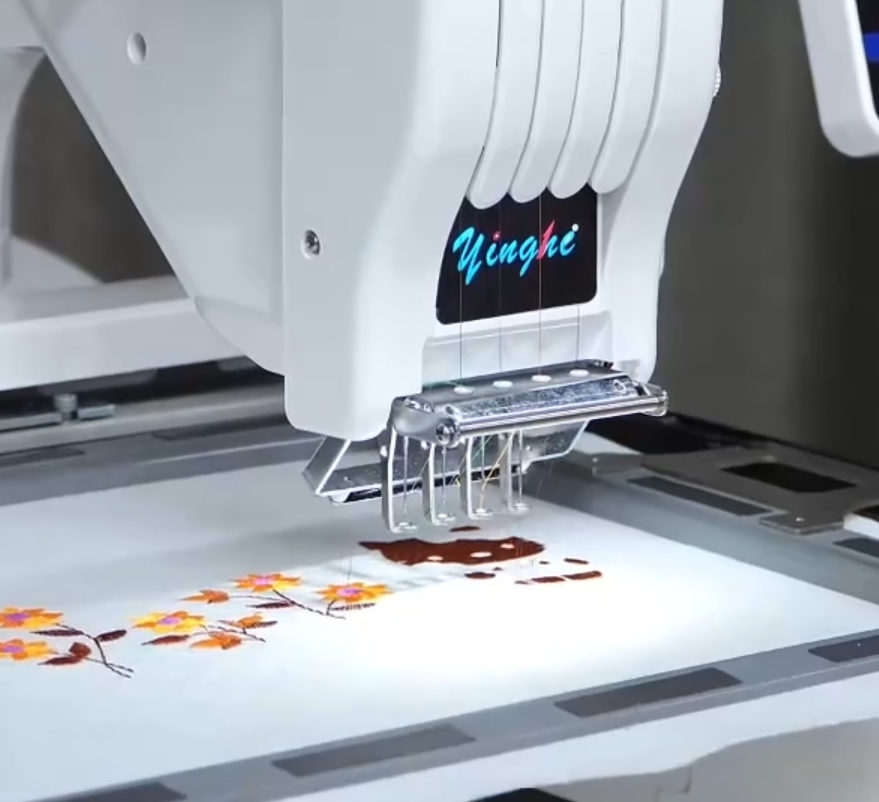
  • No frequent downtime for manual thread replacement Non-automatic embroidery machines halt completely for every color switch. Operators need to cut threads, replace spools, re-thread, and adjust tension manually, with each color change taking 30 seconds to 1 minute. Patterns with dozens of color changes waste massive amounts of production time waiting for manual operation. Automatic color-changing embroidery machines receive program commands, and the servo motor of the needle head automatically rotates to switch colored threads, finishing the color change within 1 second without interrupting machine operation.
  • One operator can oversee multiple machines Models with 4 or more needles supporting automatic color change require no manual intervention mid-production. A single operator can simultaneously manage 3 to 5 machines, drastically cutting labor hours and costs. Consistent production without repeated thread replacement also stabilizes finished product quality.

2. Broader Scope of Order Acceptance

Traditional embroidery machines have limited order capacity: without automatic color switching, they can only produce text and simple monochrome logos. Orders with 3 or more color schemes are unworkable and must be rejected.
Automatic color-changing embroidery machines accept a wider range of orders: multiple thread colors can be preloaded at once, enabling embroidery with gradients, shadows, and multi-layer complex patterns. They can fulfill orders for streetwear brands, children’s clothing, cultural and creative merchandise, traditional Chinese-style products, and multi-color work uniforms. Multi-color automatic switching creates embroidery with strong layering and high color restoration, qualifying as high-value customized goods with higher quoting prices and larger profit margins.

3. Lower Operational Barriers and Reduced Component Wear

  • Shorter training for new staff Manual color changing involves cumbersome procedures, and re-threading, tension adjustment, and bobbin replacement demand skilled experience, making it hard for new hires to master quickly. Automatic color change only requires preloading all colored threads once at the start; one-click startup enables fully automatic operation, and zero-experience workers can operate the machine after brief training.
  • Less thread and accessory consumption Non-automatic machines require frequent manual thread pulling and tensioner disassembly, which wears springs and scratches embroidery threads, leading to frequent breakage and higher thread consumption. Automatic color-changing machines operate with smooth, stable mechanical movements, cutting thread waste and lowering the frequency of replacement for wear-prone machine parts, saving long-term costs on consumables and maintenance.

4. Suitability for Long-Term Continuous Mass Production

Automatic color-changing embroidery equipment supports large-batch mass production with long hours of unattended continuous embroidery. It effectively cuts labor, consumable, and time costs, significantly lowering overall comprehensive production expenses.

5.Automatic Color-Changing Embroidery Machines Deliver Better, More Stable Product Quality

  1. No pattern misalignment or displacement Manual color changing requires lifting the embroidery frame, shifting fabric, and replacing spools, which easily displaces the fabric and causes misaligned color blocks and disjointed patterns that render products defective. Automatic color changing keeps the embroidery frame and fabric fixed in place; only the needle head rotates to switch threads, delivering precise pattern alignment free of offset defects.
  2. Stable thread tension with fewer flaws Tightness must be re-adjusted manually after every color change on traditional machines. Over-tight tension snaps threads, while loose tension creates floating reverse-side threads, resulting in inconsistent stitch tightness across a single embroidered piece after repeated adjustments. Automatic models feature independent fixed tension for each needle, and tension parameters remain unchanged during color switching. Every stitch on the finished product is uniform, drastically reducing defects including skipped stitches, thread breakage, and floating threads.
  3. No raised thread knots, ideal for high-end premium orders Operators may cut corners by tying knots during manual thread replacement, leaving protruding knots under the fabric that create uneven bumps. Such flaws are unacceptable for apparel, high-end home textiles, and gift orders. Automatic color changing eliminates manual thread splicing, delivering smooth, delicate fabric surfaces and qualifying manufacturers to take high-standard premium custom embroidery orders.

Recommendation: Yinghe Automatic Color-Changing Embroidery Machines

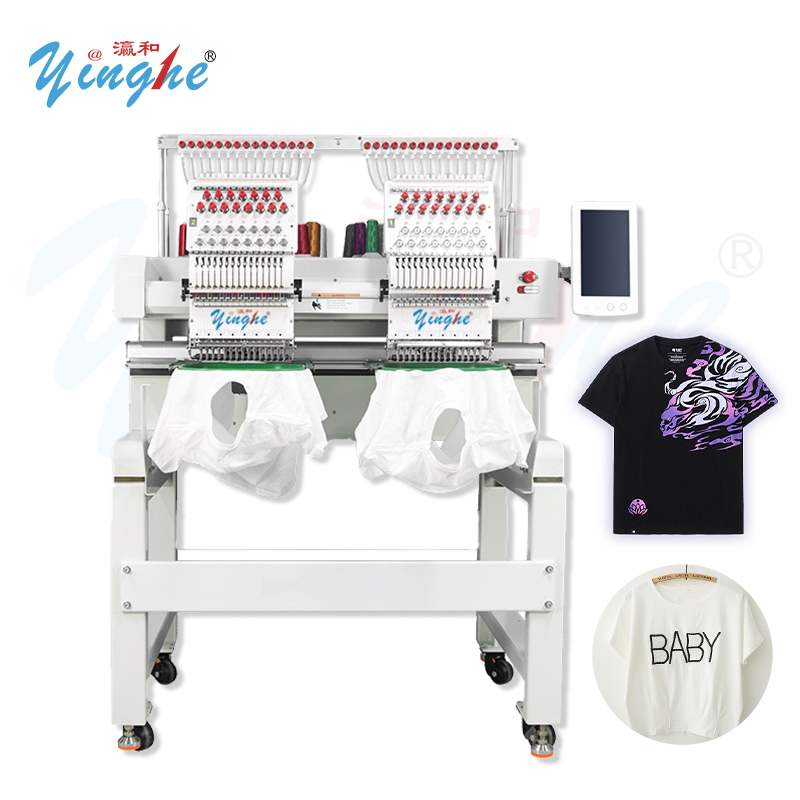
We recommend Yinghe industrial computerized embroidery machines, all fully equipped with a stable intelligent automatic color-changing system. The machines eliminate frequent manual downtime for thread replacement and greatly boost mass production efficiency. Available models cover multiple specifications: 8-needle single-head, 8-needle double-head, 12-needle single-head, 12-needle double-head, 15-needle single-head, and 15-needle double-head units. 8-needle models meet basic multi-color customization demands, while 12-needle and 15-needle machines hold more thread colors at once, effortlessly handling complex multi-color patterns such as gradients, florals, cartoons, and traditional Chinese motifs. Single-head machines suit small-batch custom work for embroidery shops and studios, while double-head models enable simultaneous embroidery on two stations to double output capacity. The equipment supports long hours of unattended continuous operation, cutting comprehensive costs for labor, consumables, and time. Whether for newly launched embroidery stores or large-scale processing factories, there is a matching model to satisfy production needs, balancing embroidery precision and flexible order acceptance.