
What Machine Is Best for Embroidery

The most suitable embroidery machine is one specifically designed for a particular type of embroidery. No single embroidery machine can handle all types of embroidery, but some models can achieve multi-functional embroidery effects by replacing or adding supporting accessories.
1. Which Machine Is Best Suited for Embroidery?
When we need to purchase embroidery equipment, we must fully understand our requirements, such as the main types of embroidery in daily production, production scale, usage scenarios, as well as operational difficulty and subsequent maintenance.
Embroidery machines come in a wide variety and can be classified based on different dimensions such as embroidery functions, mechanical structure, and application scenarios.

2.The main types of embroidery each is suitable for are listed below:
2.1 Functional Classification
Embroidery machines can be divided into various special-purpose or multi-functional hybrid models:
- Plain Embroidery Machine: A basic model suitable for regular flat embroidery.
- Sequins Embroidery Machine: Can achieve single-sequin, double-sequin, stacked-sequin and other effects to enhance decorativeness.
- Towel Embroidery Machine: Specifically designed for three-dimensional embroidery on towels and similar fabrics.
- Cord Embroidery Machine (Winding Embroidery Machine): Forms raised textures by winding threads, commonly used in home textiles or children's clothing.
- Laser Embroidery Machine: Integrates laser technology for precise embroidery.
- Velvet Embroidery Machine: Used for flocking processes to improve the tactile feel of embroidered products.
- Garment/Cap Embroidery Machine: Custom-designed for curved items such as caps and finished garments.
- High-Speed Embroidery Machine: Emphasizes production efficiency, suitable for large-batch operations.
In addition, multi-functional hybrid models such as the "Three-in-One" (Plain Embroidery + Sequins Embroidery + Cord Embroidery) or "Four-in-One" (Plain Embroidery + Sequins Embroidery + Simple Cord Embroidery + Towel Embroidery) integrate multiple functions to enhance flexibility.
2.2 Structural Classification
Mainly divided by the number of heads, number of needles, and feeding method:
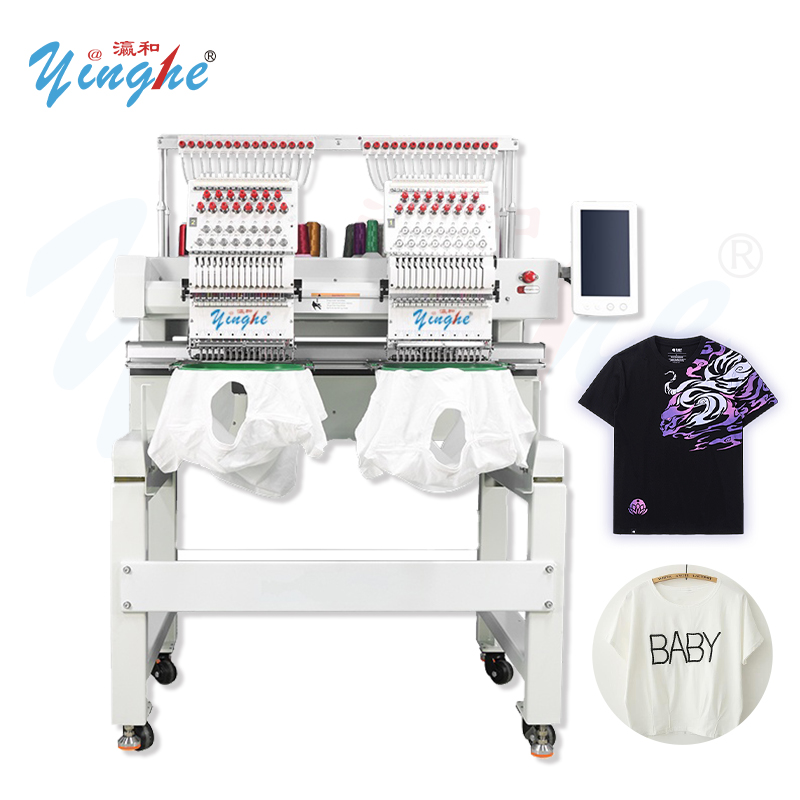
- Number of Heads: Divided into single-head machines and multi-head machines (e.g., 2-24 heads). Multi-head machines are suitable for large-scale production.
- Needle Configuration: Each head can be equipped with a single needle or multiple needles (e.g., 3-12 needles). The multi-needle design improves efficiency.
- Feeding Method: Includes two types: plate-type and cylinder-type.