
Embroidery Needle Model List: Which Fabrics Are Suitable for Each Needle Size
Embroidery Needle Model List: Which Fabrics Are Suitable for Each Needle Size
The quality control in embroidery production often lies in the details that are most easily overlooked. Most production lines repeatedly check equipment speed, needle plate alignment, and thread path tension, but often neglect the precision match between the embroidery needle and the fabric. Common issues on the shop floor—such as fabric fraying, thread looping, and frequent needle breakage—directly impair overall production efficiency.
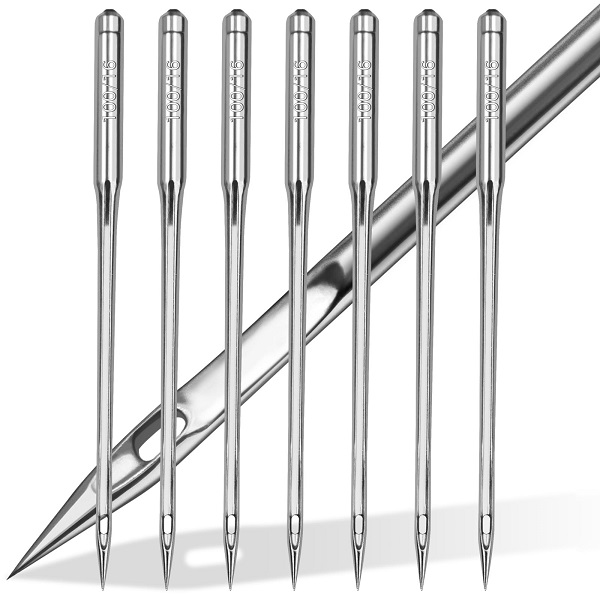
As the primary penetrating component in contact with the fabric, the embroidery needle's shaft diameter, point geometry, and eye size determine the quality of every stitch. Industrial embroidery needles commonly used in garment factories cover the standard size range from 60/8 to 140/22 (metric sizes 0.60 mm to 1.40 mm), corresponding to different fabric weights and fiber characteristics. This article systematically analyzes the application scenarios and process parameters for each needle size from an industrial production perspective, providing a clear reference for production line technicians and purchasing teams.

The Core Logic of Needle Sizing
The size of an embroidery needle is determined by the diameter of its shaft. Each incremental size increase corresponds to a fixed growth in shaft diameter, accompanied by a proportional expansion in eye size, thread groove depth, and structural rigidity. Fine needles minimize puncture marks, making them suitable for high-density, lightweight textiles. Coarser needles provide high structural strength to penetrate thick, multi-layered materials under high thread tension.
In addition to shaft diameter, needle point geometry dictates fabric adaptability:
- Sharp Points (SPI/RS): Ideal for woven fabrics, precisely piercing between threads to prevent puckering.
- Light Ball Points (SES): Recommended for elastic and knitted fabrics, pushing fibers aside during penetration to avoid enlarged holes and runs.
- Cutting Points (TRI/LR): Designed for real and synthetic leather, cleanly slicing through non-woven layers to minimize puncture resistance.
Fabric Adaptation and Process Scenarios for Each Needle Size
Size 60/8 (0.60 mm Shaft Diameter)
Size 60/8 is the ultra-fine needle size for industrial production. Its small eye accommodates fine synthetic silk or 120D/below fine-denier polyester threads. Engineered specifically for ultra-thin, high-density textiles, it completes delicate embroidery on materials such as silk chiffon, jacquard weave, and organza without leaving visible needle marks. It is ideal for high-end custom dresses and silk scarves. Machine operating speed should be capped at 60% of maximum rated speed to prevent shaft deflection.
Size 65/9 (0.65 mm Shaft Diameter)
Size 65/9 offers slightly higher rigidity than size 60/8 while remaining in the fine-gauge category. Lightweight fabrics like silk crepe de chine, high-count combed cotton, and voile are best embroidered with this size. It excels at delicate collar logos and intimate wear patterns, maintaining an extremely low fabric damage rate. It pairs with fine polyester thread, with operating speeds kept within 70% of maximum rated speed.
Size 70/10 (0.70 mm Shaft Diameter)
Size 70/10 balances fine precision with improved structural stability. Standard silk fabrics, 40s high-count cotton, and light jersey knits can be processed with high quality. It handles scattered dress motifs and large silk scarf patterns. Accommodating 75D rayon and standard fine polyester threads, it provides better continuous running stability for small-batch precision orders. Equipment speed can be raised to 75% of maximum rated speed.
Size 75/11 (0.75 mm Shaft Diameter)
Size 75/11 serves as a universal needle for transitioning from lightweight to standard fabrics. It is widely used for 32s cotton fabric, standard linen, light denim, and knits. T-shirt logos, casual shirt patterns, and lightweight canvas packaging achieve clean embroidery surfaces with this size. Compatible with both polyester and rayon threads, it offers low break rates and high operational stability, making it a staple for small embroidery operations. Recommended speed is around 80%–85% of maximum rated speed.
Size 80/12 (0.80 mm Shaft Diameter)
Size 80/12 is the standard universal needle size for regular apparel fabrics. Materials like 21s standard cotton, linen blends, and sweatshirt fleece embroidered with this size achieve uniform stitch density. It easily accommodates 40/2 spun polyester and standard embroidery threads, making it ideal for continuous, high-speed runs on volume apparel orders. Equipment can operate at 100% standard operating speed.
Size 85/13 (0.85 mm Shaft Diameter)
Size 85/13 is engineered for medium-weight fabrics such as corduroy, light woolens, Oxford cloth, and multi-layer workwear shirts. Its increased rigidity allows it to penetrate two layers of standard woven fabric smoothly while maintaining a clean thread path. Suitable for home textiles and uniform production lines, operating at standard rated speed.